Rock music did not suddenly appear when teenagers started buying electric guitars in the 1950s.
Long before rock became a global phenomenon, African American musicians were already developing many of the sounds, rhythms, and performance styles that would define it.
One of the strongest foundations was rhythm and blues, usually shortened to R&B. Emerging as a commercial term during the 1940s, R&B brought together elements of blues, jazz, boogie-woogie, gospel, and African American swing.
The Library of Congress notes that these styles became important building blocks for rock and roll only a few years later.
Understanding how rhythm and blues influenced modern rock music means looking beyond a simple genre family tree. Rock inherited R&B’s strong backbeat, blues-based harmony, emotional singing, electric instrumentation, and focus on danceable energy.
Artists then mixed those ingredients with country, gospel, pop, and other musical traditions. The result was not a complete break from the past, but a louder and increasingly youth-focused evolution of sounds that were already transforming American music.
Rhythm and Blues Created the Musical Foundation for Rock
The term “rhythm and blues” became widely used during the late 1940s as a way of describing African American popular music.
The Library of Congress explains that the category originally covered several related traditions, including blues, boogie-woogie, jazz, and African American swing. As musicians moved between cities and musical communities, these styles increasingly overlapped.
That mixture mattered because early rock and roll used many of the same musical ingredients.
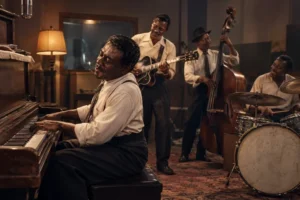
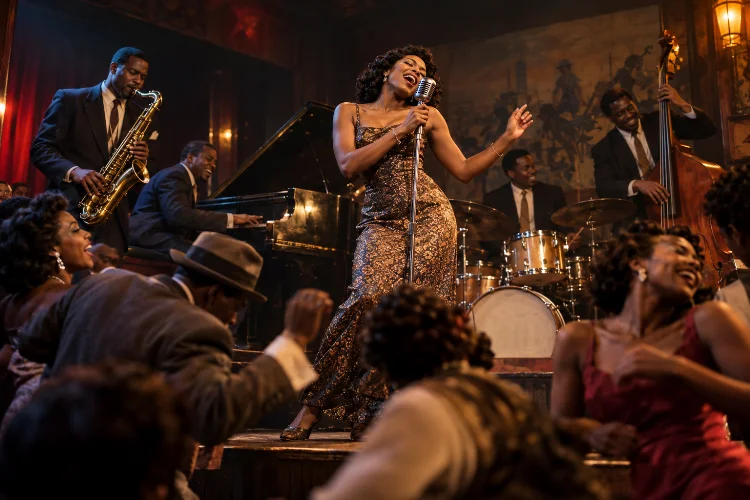
A typical R&B performance could include piano, drums, bass, electric guitar, saxophone, and a strong vocalist. Instead of highly complex arrangements, many songs emphasized memorable riffs, simple chord progressions, and rhythms designed for dancing.
Early rock musicians kept much of that formula.
What changed was often the presentation. Tempos became more aggressive, guitars became more prominent, lyrics increasingly targeted teenage audiences, and performers developed a more rebellious public image.
Musically, however, the connection remained obvious.
The R&B Backbeat Became the Heartbeat of Rock and Roll
Perhaps the most important rhythmic contribution of R&B was the emphasis on the backbeat.
In common 4/4 time, musicians count four beats in each bar: one, two, three, four. Earlier popular styles often placed strong emphasis on beats one and three. Rhythm and blues increasingly made beats two and four feel powerful, frequently through the snare drum.
That simple change had a massive effect.
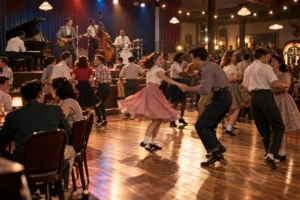
The strong backbeat created an immediate physical pulse that made the music ideal for dancing. When early rock musicians adopted the same approach, it became one of the easiest ways to recognise the emerging rock and roll sound.
Electrified urban blues also helped prepare the way. PBS describes how blues musicians moving into cities such as Chicago began using electric guitars, drums, harmonica, and bass, producing a stronger rhythmic sound that pointed toward both R&B and rock and roll.
Rock musicians intensified that idea rather than replacing it.
Turn up the tempo, emphasize beats two and four, add a powerful singer and a sharp guitar riff, and much of the basic early-rock formula is already there.
Blues Harmony Gave Rock a Simple but Powerful Structure
Rhythm and blues also carried blues harmony directly into rock music.
Many R&B songs relied on familiar blues chord relationships, especially progressions based around the I, IV, and V chords. The 12-bar blues form was particularly useful because musicians could create countless songs around the same underlying structure.
This simplicity gave performers freedom.
A singer could improvise phrases while guitarists or pianists added fills between vocal lines. Soloists already understood where the chord progression was heading, making spontaneous performance relatively easy.
Early rock musicians used exactly the same advantage.
Chuck Berry, for example, combined blues and R&B harmony with country influences and highly distinctive guitar playing. The Rock & Roll Hall of Fame describes his style as a combination of country, blues, and R&B that became hugely important to the formation of rock and roll.
Rock therefore did not need complicated harmony to sound revolutionary. Familiar structures provided a stable foundation while performers experimented with volume, tone, speed, and attitude.
R&B Vocal Styles Made Rock Performances More Emotional
Another major influence came from the human voice.
Rhythm and blues singers rarely approached a song as if every note had to sound perfectly polished. Performers could shout, bend notes, use rasp, slide between pitches, repeat phrases, or dramatically change volume.
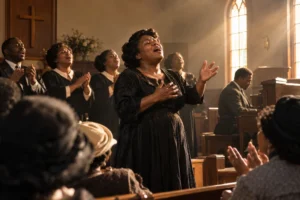
Many of those techniques had deeper connections to blues and gospel.
This expressive freedom became essential to rock vocals. Little Richard’s explosive delivery, Fats Domino’s relaxed phrasing, and later generations of rock singers all demonstrated different ways a voice could function as more than a vehicle for melody.
The emotional attitude mattered just as much as pitch.
A singer could sound excited, frustrated, seductive, playful, or defiant. Those characteristics helped rock feel more immediate than much of the carefully controlled mainstream pop that surrounded it.
The developement also influenced stage performance. Rock singers increasingly moved, shouted, interacted with audiences, and treated performance as a physical experience.
That approach remains central to rock concerts today.
Fats Domino Helped Turn New Orleans R&B Into Rock and Roll
The transition between R&B and rock becomes particularly clear when listening to Fats Domino.
Domino did not suddenly abandon rhythm and blues and decide to invent an entirely different genre. Instead, his New Orleans sound gradually became recognised as part of the emerging rock and roll movement.
His style combined rolling boogie-woogie piano, blues harmony, strong rhythm, and an approachable vocal delivery.
PBS describes Domino as one of rock and roll’s key inventors and explains how his New Orleans rhythm and blues evolved into a sound that attracted both Black and white audiences.
The Rock & Roll Hall of Fame similarly notes that the New Orleans R&B style he played became part of the newly developing rock and roll genre.
This is important because it shows how blurry the genre boundary actually was.
Music historians can assign labels afterward, but musicians and audiences often experienced the transition more gradually. The groove, piano patterns, harmony, and vocal style remained recognisably rooted in R&B even as the music became marketed as rock and roll.
Electric Instruments Gave R&B – and Rock – a Bigger Sound
Amplification changed popular music dramatically.
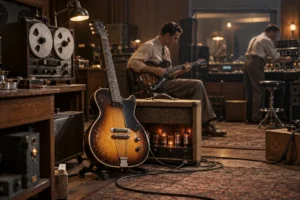
As electric guitars became more practical and affordable, R&B groups could produce stronger sounds without requiring large ensembles. Electric bass, amplified guitar, microphones, and increasingly powerful recording equipment gave smaller bands much greater impact.
This changed arrangements.
A guitarist could play a short repeated riff and still cut through the drums and piano. Bass lines became easier to hear. Singers could perform with greater dynamic range without having to compete acoustically against the band.
Rock inherited this amplified language almost immediately.
Early guitarists took blues and R&B phrases and made them louder, brighter, and sometimes deliberately rougher. Amplifier breakup and distorted guitar sounds slowly became desirable rather than technical mistakes.
The instrument most strongly associated with modern rock was therefore already being shaped inside earlier African American musical traditions.
Rock simply pushed the volume further.
Chuck Berry Turned R&B Guitar Ideas Into Rock Anthems
If Fats Domino demonstrated the piano-driven connection between R&B and rock, Chuck Berry helped establish the electric guitar as rock’s signature instrument.
Berry used blues-derived double-stops, repeated riffs, rhythmic chord patterns, and short guitar solos. But he combined them with an energetic performance style and lyrics about cars, romance, school, dancing, and teenage life.
That combination was incredibly influencial.
The Rock & Roll Hall of Fame credits Berry with absorbing blues, R&B, and country influences and transforming them into a distinctive guitar technique that played a central role in rock and roll’s development.
His recordings also demonstrated the importance of the opening guitar riff.
Instead of waiting for a singer to establish a song’s identity, the guitar could announce it immediately. That concept later became fundamental to bands ranging from The Beatles and The Rolling Stones to AC/DC and countless others.
Modern rock’s obsession with memorable riffs owes a great deal to this early meeting between electric guitar and R&B vocabulary.
R&B Helped Rock Cross Cultural and Racial Boundaries
The influence of R&B was not limited to musical technique. It also changed who was listening to popular music.
After World War II, younger audiences increasingly encountered African American music through radio broadcasts, jukeboxes, records, and live performances.
The Library of Congress notes that rhythm and blues gained a wider youth audience during the postwar period and contributed to changes in America’s racial and musical boundaries.
White artists also began recording versions of songs originally written or performed by African American musicians.
The process was complicated.
Crossover exposure introduced R&B styles to huge new audiences, but African American originators did not always receive equal commercial rewards or recognition.
Still, the cultural exchange dramatically affected popular music.
Bill Haley, for example, blended country and R&B before rock and roll was fully established as a commercial genre.
Elvis Presley and rockabilly performers similarly encountered African American music through radio stations and regional musical communities, then mixed those sounds with country traditions. PBS describes rockabilly as an important precursor to rock and roll.
Rock was therefore never musically seperated from the cultures that produced rhythm and blues.
From Early R&B to the Sound of Modern Rock
The relationship did not end when rock and roll became a recognised genre.
British musicians during the 1960s rediscovered American blues and R&B records and transformed those influences again. Bands such as The Rolling Stones openly drew from African American blues traditions, helping bring those musical ideas into another generation of rock.
From there, R&B-derived ideas spread into garage rock, hard rock, punk, heavy metal, and alternative music.
Listen carefully and the connections remain surprisingly clear.
A distorted guitar riff may still use a blues scale. A hard-rock drummer may emphasize the same backbeat that drove 1940s and 1950s R&B. A singer may bend notes or use call-and-response phrasing rooted in much older African American musical traditions.
Technology changed enormously, but the rhytmic and expressive DNA survived.
That is why understanding R&B offers one of the best shortcuts to understanding rock itself.
Rhythm and blues did not merely influence rock music – it supplied many of the ingredients that allowed rock to exist.
The powerful backbeat, blues-based chord progressions, expressive vocals, electric instrumentation, danceable grooves, and riff-driven arrangements of R&B became fundamental parts of early rock and roll.
Artists such as Fats Domino and Chuck Berry demonstrated how those traditions could evolve into something fresh without losing their roots.
Later musicians amplified those ideas again, eventually creating everything from classic rock to punk and heavy metal.
So the next time you hear a driving rock beat or a bluesy guitar riff, listen beneath the volume. Exploring the R&B pioneers behind those sounds can reveal an entirely different – and much richer – story of how modern rock was born.