Rock and roll may sound louder, faster, and more rebellious than traditional blues, but underneath that energy sits a musical framework that had already been developing for decades.
Many of the genre’s earliest hits relied heavily on blues chord progressions, phrasing, rhythms, and melodic ideas.
This connection was not accidental. Blues developed within African American musical traditions in the American South before spreading into major cities and evolving into electric blues and rhythm and blues.
By the 1940s and 1950s, those styles were already creating much of the musical vocabulary that early rock musicians would adopt.
Understanding blues harmonic structures therefore offers a useful way to understand how early rock and roll actually worked. From the familiar 12-bar progression to blue notes, dominant chords, riffs, and shuffle patterns, blues gave musicians a flexible foundation.
Early rock performers did not simply copy it – they accelerated it, amplified it, mixed it with country and gospel, and turned it into something that would reshape popular music.
The 12-Bar Blues Became a Musical Blueprint
One of the most important contributions of blues to rock and roll was the 12-bar blues form.
In its simplest version, a 12-bar progression revolves around three chords built on the first, fourth, and fifth degrees of a key. Musicians commonly describe them as the I, IV, and V chords.
In the key of A, for example, those chords would be A, D, and E. A basic structure might spend four bars around the I chord, move toward IV, return to I, and then use V and IV before resolving home again.
The Library of Congress describes the 12-bar blues as the dominant blues song form that developed early in the genre’s history.
It became remarkably durable because musicians could easily change melodies, lyrics, tempos, and instrumental parts while keeping the harmonic skeleton recognizable.
That flexibility was perfect for early rock and roll. Instead of needing complicated harmonic changes, performers could build excitement through tempo, vocal delivery, guitar riffs, piano patterns, and a stronger backbeat.
Why the I–IV–V Progression Worked So Well
The I–IV–V relationship sounds simple, but that simplicity is one of its greatest strengths.
The I chord gives the music a sense of home. Moving to IV creates motion without making the song feel completely unstable, while the V chord produces tension that naturally wants to resolve back toward I.
Blues musicians had already learned how much expression could be squeezed from these few chords. Early rock musicians pushed the same idea into a louder and more rythmically aggressive setting.
This approach also made songs easier for bands to learn and perform. Musicians who understood the basic pattern could follow unfamiliar songs, improvise fills, or extend performances without depending entirely on written arrangements.
For rock and roll, that was incredibly useful. The music was often built around immediacy and physical energy rather than elaborate harmonic sophistication. A simple progression left more room for personality.
Blue Notes Added Tension and Attitude
Harmony was only part of the blues influence. Another crucial ingredient was the use of blue notes.
Blues performers often altered or bent certain scale tones, particularly the third, fifth, and seventh degrees.
Instead of landing neatly on pitches associated with a conventional major scale, singers and instrumentalists could slide between notes, flatten them, or bend upward toward them. The Library of Congress identifies these blue notes as a defining feature of the blues sound.
That tension between major harmony and blues-inflected melody became central to rock and roll.
A song might use relatively bright major chords while the singer or guitarist plays notes that sound rougher, darker, or more emotionally ambiguous. That clash gives the music much of its edge.
Early rock guitarists turned this vocabulary into short fills, double-stops, bent notes, and memorable solos. Even as guitar equipment became louder and performances more energetic, the expressive language remained closely connected to blues phrasing.
Shuffle Rhythms Helped Create the Rock and Roll Groove
Rock and roll was not shaped by harmony alone. Blues rhythm mattered just as much.
Many blues and rhythm-and-blues recordings used shuffle or swing-based subdivisions rather than perfectly even eighth notes. Instead of every beat feeling mechanically straight, the groove leaned forward with an uneven long-short pulse.
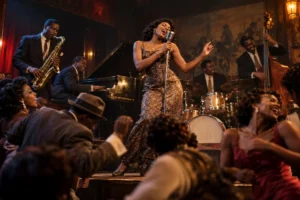
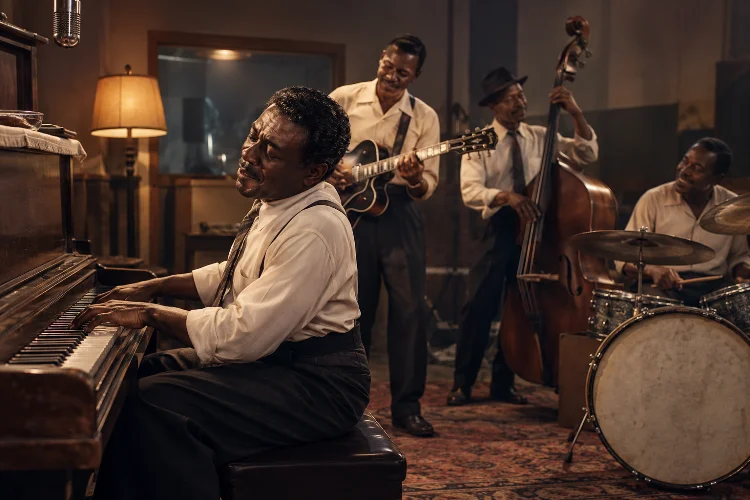
As blues musicians migrated to cities such as Chicago and Detroit, the genre increasingly adopted electric guitars, drums, harmonica, and amplified ensembles. PBS notes that this electrified blues sound helped point directly toward rhythm and blues and rock and roll.
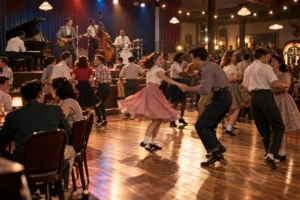
Early rock musicians often tightened and intensified that feel. Drummers emphasized the backbeat on beats two and four, while pianists and guitarists played repeating rhythmic patterns around it.
The result was music designed to move people physically. Blues supplied much of the underlying groove; rock and roll made it louder, faster, and harder to ignore.
Repeating Blues Riffs Became Rock Guitar Language
One of the clearest connections between blues and rock appears in the guitar.
Blues musicians frequently built songs around repeating instrumental figures rather than constantly changing chord voicings. These riffs could outline the underlying harmony while simultaneously creating a catchy rhythmic hook.
Chuck Berry became one of the most important figures in transforming that approach into early rock guitar vocabulary.
The Rock & Roll Hall of Fame notes that Berry combined blues, R&B, and country influences into a distinctive guitar style that played a major role in the formation of rock and roll.
Listen to the guitar introductions and fills associated with Berry’s recordings and the blues relationship becomes easy to hear. Short phrases, chord-based riffs, bends, and repeated figures create musical identity almost instantly.
This was a major developement in popular music. The guitar was no longer simply accompanying singers. It was becoming one of the central voices of the song.
Early Rock Musicians Expanded the Blues Formula
Early rock and roll was not simply blues played faster.
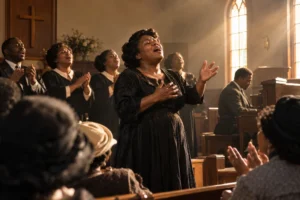
Musicians combined blues harmonic structures with gospel vocals, boogie-woogie piano, country guitar techniques, swing, jump blues, and other traditions. That mixture explains why rock and roll developed several recognizable variations almost immediately.
Memphis and St. Louis were particularly important meeting points. PBS describes these cities as places where blues mixed with gospel and country traditions, helping create some of the earliest forms of rock and roll.
Rockabilly provides another obvious example. Artists associated with that style combined country performance traditions with strong blues and rhythm-and-blues influences.
PBS identifies rockabilly as an important precursor to rock and roll and connects the style with performers such as Elvis Presley, Carl Perkins, Jerry Lee Lewis, and Wanda Jackson.
So while blues provided a harmonic foundation, the emerging rock sound was never completely seperated from other American musical traditions.
Chuck Berry and Little Richard Showed How Flexible the Blues Could Be
Individual performers reveal how differently musicians could use similar musical foundations.
Chuck Berry often built energetic songs around blues-derived chord patterns and guitar figures while writing lyrics about cars, school, dancing, and teenage life.
The familiar harmonic language made his songs accessible, while his guitar playing and subject matter helped define a new youth-oriented style.
Little Richard took another path. His pounding piano, explosive vocals, gospel-influenced delivery, and driving rhythms pushed rhythm and blues toward a far more theatrical form of rock and roll.
The Rock & Roll Hall of Fame describes his performances and visceral rhythms as foundational to the future sound of the genre.
Their music shows why blues harmony was so influencial. The underlying structures were stable enough to support radically different personalities.
The same I–IV–V framework could become gritty, joyful, aggressive, humorous, romantic, or wild depending on the performer.
Blues Harmony Gave Rock and Roll Room to Rebel
There is an interesting paradox at the heart of early rock and roll: much of its rebellious sound came from relatively simple musical structures.
That simplicity was actually an advantage.
Because the harmonic framework was predictable, musicians could experiment elsewhere. Singers could scream, whisper, bend phrases, or improvise.
Guitarists could add distorted notes and solos. Pianists could hammer repeated figures. Drummers could make the backbeat increasingly powerful.
Audiences could also understand the structure without thinking about it. After hearing a few bars, listeners instinctively knew where the music was heading.
This combination of familiarity and intensity helped early rock become accessible without sounding tame. The harmonic rules provided stability while performers supplied the danger.
Blues did far more than simply influence early rock and roll from a distance. Its harmonic language became part of the genre’s basic musical architecture.
The 12-bar form, I–IV–V chord movement, blue notes, repeated riffs, shuffle rhythms, and expressive improvisation gave early rock musicians a powerful framework they could reshape.
Artists such as Chuck Berry and Little Richard demonstrated that relatively simple harmonic ideas could support completely new sounds, performances, and cultural identities.
Learning these blues harmonic structures makes early rock and roll much easier to understand – and often more interesting to hear.
Next time you listen to a classic 1950s rock track, follow the chord movement, guitar riffs, and vocal bends. Chances are, you will hear the blues running underneath it.