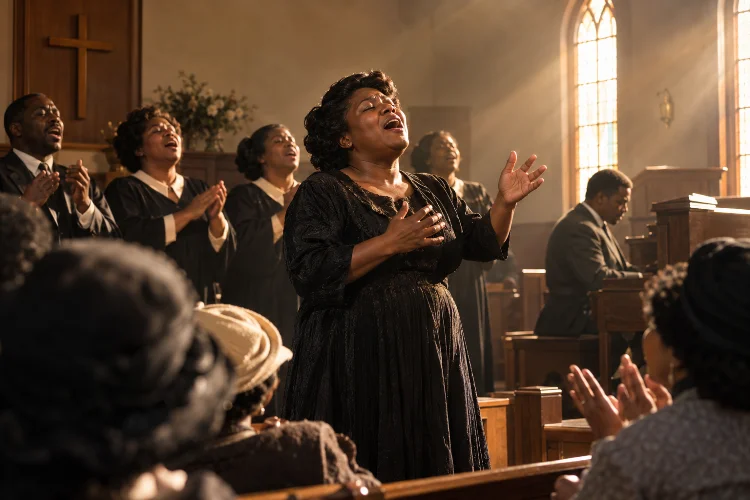
When early rock singers shouted, stretched syllables, jumped between soft and explosive passages, or worked an audience into a frenzy, they were not inventing those techniques from scratch.
Many had heard similar vocal energy years earlier in churches, gospel quartets, and religious gatherings. African American gospel developed from spirituals, church singing, blues influences, and highly expressive worship traditions.
By the 1930s and 1940s, gospel performers were using improvisation, rhythmic phrasing, strong harmony, and emotionally intense delivery in ways that would eventually become familiar ingredients of popular music.
The Library of Congress describes gospel as rhythmic spiritual music rooted partly in solo and responsive church singing in the African American South.
Understanding how gospel vocal traditions influenced early rock performance helps explain why the first generation of rock singers sounded so different from many mainstream pop vocalists.
Rock borrowed more than individual notes from gospel. It inherited a philosophy of performance: do not simply sing the song – make the audience feel it.
Gospel Made Singing an Emotional Experience
One of gospel’s greatest contributions to early rock was emotional intensity.
Traditional popular singers often aimed for controlled phrasing, smooth tone, and clear pronunciation. Gospel performers had different possibilities.
A vocalist might begin quietly, repeat a phrase, increase the volume, roughen the voice, and eventually push the performance into an emotional climax.
That approach turned singing into a journey.
African American gospel grew partly from spiritual traditions and the enthusiastic worship practices associated with churches such as Holiness and Pentecostal congregations. Gospel also absorbed blues-influenced intervals, rhythmic energy, and improvisation.
Early rock singers brought that intensity into secular music.
Instead of treating a romantic or dance song as something that needed to stay technically polished, performers could shout, growl, bend notes, or break their voices slightly for dramatic effect.
The imperfect sound became part of the emotion.
Call-and-Response Became a Rock Performance Tool
Another crucial gospel technique was call-and-response.
In church settings, a lead singer or preacher might deliver a musical phrase and receive an answer from the choir or congregation. The exchange could repeat and grow more energetic as the performance continued.
This created participation rather than passive listening.
Early rhythm and blues carried similar techniques into secular music, with vocal groups drawing heavily from gospel harmony and singing styles.
The Library of Congress notes that postwar R&B combined gospel with blues, jazz, and pop, while vocal groups of the period often took inspiration directly from gospel singers.
Rock musicians adapted that formula in several ways.
A singer could shout a line and receive a response from backing vocalists. Guitar or piano phrases could answer the vocal melody. Audiences could also become part of the pattern through clapping, shouting, or repeating simple choruses.
The idea eventually became standard concert language.
When a rock singer points the microphone toward the crowd and expects thousands of people to finish a line, the basic principle is closely related to an older participatory musical tradition.
Gospel Singers Used Their Voices Like Instruments
Gospel vocals were rarely limited to simply reproducing written melodies.
Singers could reshape them.
A single note might be bent, decorated, delayed, or extended across several beats. Singers frequently used melisma—the technique of singing several notes on one syllable—to increase emotional expression.
Changes in vocal texture mattered too.
A performer might shift from a clean note into rasp, a cry, a shout, or a controlled scream. Small variations could turn a familiar melody into something deeply personal.
These techniques became extremely important in rock.
Little Richard provides one of the clearest examples. His vocals were packed with screams, shouted phrases, rhythmic repetition, and dramatic changes in intensity.
Combined with his pounding piano and theatrical stage presence, they created a performance style that helped define rock and roll in the 1950s. The Rock & Roll Hall of Fame describes his performances as unrestrained and his stage presence as a major influence on rock’s future direction.
He was singing songs for dancing and entertainment, but much of the performence intensity had roots in church music.
Sister Rosetta Tharpe Connected Gospel Directly to Rock
Few musicians demonstrate the gospel-rock connection better than Sister Rosetta Tharpe.
Tharpe became famous decades before rock and roll reached its commercial peak. She combined powerful gospel vocals with rhythmic electric-guitar playing, bringing sacred music into performance environments that could feel remarkably close to later rock shows.
The Rock & Roll Hall of Fame calls Tharpe the first guitar heroine of rock and roll and highlights both her powerful voice and groundbreaking guitar work.
Her importance goes beyond the instrument.
Tharpe performed gospel with physical energy, confidence, humor, rhythmic freedom, and dramatic audience interaction. She demonstrated that religious performance could be exciting, amplified, and visually commanding.
That combination became a blueprint for later performers.
The boundary between gospel and secular popular music was still culturally significant, especially within religious communities. But musically, Tharpe showed that many of the sounds associated with rock already existed well before the genre was officially named.
Little Richard Brought Church Energy to Rock and Roll
Little Richard’s relationship with gospel was especially strong.
Growing up around religious music, he absorbed the vocal excitement and emotional intensity of church performance before becoming one of rock and roll’s most explosive stars.
Listen to his classic recordings and the connection becomes easy to hear.
He attacks syllables rather than simply delivering them. High notes become screams. Short phrases repeat until they feel almost hypnotic. His voice pushes against the rhythm instead of sitting politely on top of it.
That vocal approach changed how rock singers could behave.
Performance no longer needed to appear effortless. Sweat, strain, physical movement, and even a certain amount of vocal chaos could make the music more powerful.
Little Richard also expanded the visual language of rock. His clothing, movement, hair, expressions, piano playing, and voice all worked together as one performance.
The Rock & Roll Hall of Fame describes him as an artist who exploded onto the 1950s scene with thunderous piano and electrifying stage presence.
In other words, gospel’s intensity did not just enter rock vocals. It helped shape the entire stage experience.
Elvis Presley Carried Gospel Phrasing Into Mainstream Rock
Gospel also had an important influence on Elvis Presley.
His musical background brought together country, blues, rhythm and blues, pop, and religious music. The Library of Congress notes that gospel was among Presley’s early influences and that he sang it from childhood in Pentecostal churches.
That influence can be heard in his phrasing.
Presley frequently stretched notes, moved between soft and forceful passages, added small vocal decorations, and allowed his tone to become rougher when the emotion demanded it.
His connection with gospel continued even after he became famous for rock and roll.
Graceland’s official biography identifies the gospel music he heard in church and at all-night gospel sings as an important part of his musical background.
Presley’s success also helped bring gospel-influenced vocal techniques to a huge mainstream audience.
The result was complicated culturally because many of those musical traditions originated within African American communities. Still, his recordings demonstrate how deeply church-influenced singing had entered the vocabulary of early commercial rock.
Ray Charles Blurred the Line Between Sacred and Secular Singing
Ray Charles provides another revealing example of gospel vocabulary moving into popular music.
Charles combined gospel intensity with blues and R&B, playing an important role in the development of soul. The Rock & Roll Hall of Fame specifically credits him with combining gospel and blues into a new musical language.
One important breakthrough was his willingness to adapt musical approaches associated with religious songs to secular subjects.
The vocal emotion remained intense, but the lyrics could now discuss romantic relationships rather than worship.
That approach was sometimes controversial.
For listeners who understood the source material, the connection between church music and secular performance could sound almost shockingly direct.
Yet it proved enormously influencial.
Rock, soul, and later pop singers increasingly treated vocal expression as something capable of moving freely between sacred-sounding intensity and everyday human emotion.
Dynamic Contrast Made Early Rock Vocals Exciting
Gospel also taught performers the power of contrast.
A singer did not need to operate at maximum volume throughout an entire song. Often the most effective performance started with restraint.
A verse could feel intimate. The singer might then increase intensity through repeated phrases, stronger backing vocals, or higher notes until the chorus seemed dramatically larger.
Rock adopted this strategy almost immediately.
Quiet-to-loud dynamics created tension and release. Singers learned that holding energy back for a few seconds could make the next scream, chorus, or instrumental break feel much more exciting.
Modern rock still relies heavily on this idea.
From classic rock ballads to alternative rock songs that explode into huge choruses, dynamic contrast remains one of the easiest ways to manipulate emotional energy.
The techniqe may sound completely natural today, but its roots reach deep into participatory traditions where performers understood how to gradually lift a room.
Gospel Harmony Influenced Rock Backing Vocals
Lead singers were not the only source of gospel influence.
Vocal harmony mattered enormously.
Gospel quartets developed sophisticated ways of arranging several voices around a lead singer. One performer might carry the melody while others supplied sustained chords, rhythmic responses, or repeated vocal patterns.
The Library of Congress notes that male gospel quartets became particularly important during gospel’s early development, with groups eventually adding guitars and adapting older spiritual material into new arrangements.
These ideas flowed into R&B and doo-wop before becoming part of rock and roll.
Early rock recordings frequently used backing singers to answer lead vocals, reinforce choruses, or create a fuller sound around relatively simple instrumentation.
Later rock bands expanded the idea further.
From close three-part harmonies to enormous choir-like choruses, rock vocal arrangements continued using the basic principle that multiple voices could make an emotional moment feel much bigger than one singer alone.
Stage Presence Became as Important as the Voice
Perhaps gospel’s most overlooked influence was the relationship between performer and audience.
Church singers were not simply recording voices in isolation. They were communicating with people directly in front of them.
Movement, facial expression, repetition, spoken interjections, clapping, and improvisation could all affect the audience’s reaction.
Early rock performers adopted the same immediacy.
Little Richard attacked his piano. Elvis moved across the stage. Singers shouted directly at crowds. Musicians stretched songs when listeners responded enthusiastically.
The audience became part of the performance.
This interaction helped distinguish rock from more formal presentations of mainstream popular music.
A great rock performance was not expected to sound exactly like the studio recording. It could become louder, faster, rougher, and more spontanious.
That idea remains essential to rock culture.
Gospel vocal traditions helped give early rock performance its emotional intensity, vocal freedom, and sense of audience participation.
Call-and-response, improvisation, melisma, shouting, dynamic contrast, harmony, and dramatic stage delivery all moved from religious and gospel traditions into R&B, rock and roll, soul, and later popular music.
Artists such as Sister Rosetta Tharpe, Little Richard, Elvis Presley, and Ray Charles demonstrate different sides of that connection. They transformed familiar techniques into performances designed for new audiences without completely losing the musical language behind them.
To hear the connection yourself, compare early gospel recordings with 1950s rock vocals. Listen for repeated phrases, vocal cries, backing responses, and sudden changes in intensity. Once you recognize them, gospel’s presence in rock becomes difficult to miss.