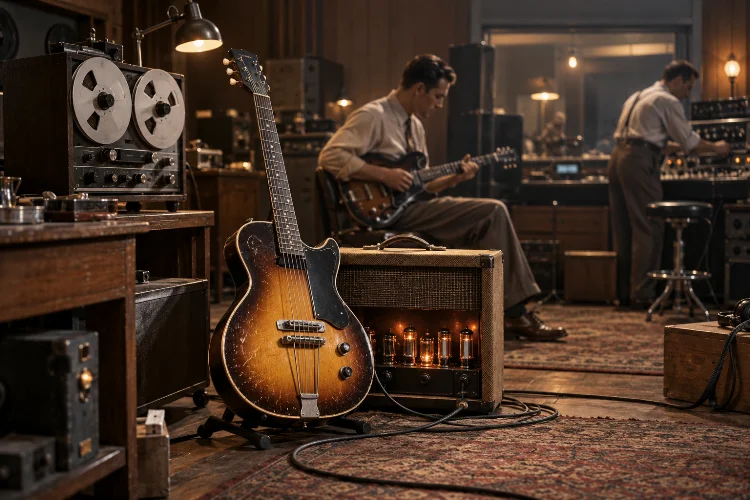
Before electric guitars became symbols of screaming solos, giant amplifiers, and walls of distortion, their role in popular music was much simpler: guitarists wanted to be heard.
During the big-band era, acoustic guitars often struggled to compete with drums, brass, and piano. Electronic amplification changed that balance.
By the 1930s and 1940s, pickups and amplifiers allowed guitarists to step forward rather than remain buried in the rhythm section. Those technological changes eventually became essential to the evolution of electric guitar sounds in early rock recordings.
When rock and roll began taking shape during the late 1940s and 1950s, guitar tone was still far from standardized. Musicians experimented with hollow-body instruments, early solid-body designs, small tube amplifiers, tape echo, overloaded speakers, and accidental distortion.
Sometimes the most influential sounds came from expensive innovations. Other times, they came from damaged equipment.
Together, those discoveries transformed the electric guitar from a louder accompaniment instrument into one of rock’s defining voices.
Before Rock and Roll, Guitarists Were Chasing Volume
The electric guitar existed before rock music did.
According to the Smithsonian, guitar makers had been searching for ways to increase volume since the early decades of the twentieth century.
Electromagnetic pickups provided a breakthrough because they converted vibrating strings into electrical signals that could be sent through an amplifier.
Early electric instruments such as Rickenbacker’s lap-steel models appeared in the 1930s, while Gibson’s ES-150 helped establish the amplified Spanish-style guitar. Jazz guitarist Charlie Christian showed that an electric guitar could do more than provide chords behind a band.
His amplified solos demonstrated that guitar could compete with horns as a melodic instrument.
That change was fundamental. By the time rhythm and blues and early rock began developing, musicians already understood that amplification could give the guitar a completely different role.
The challenge was no longer simply making it louder. Players started asking what kinds of sounds electricity could produce.
Hollow-Body Guitars Created the First Warm Electric Tones
Many early amplified guitarists used hollow-body or semi-acoustic instruments.
These guitars retained much of the resonance associated with acoustic instruments while adding electromagnetic pickups. The resulting sound was generally rounded, warm, and slightly woody compared with the sharper tones later associated with some solid-body guitars.
For early rhythm and blues performers, that tone worked beautifully. It could provide rhythm chords, blues fills, and short solos without sounding disconnected from the rest of the band.
But hollow-body designs also had limitations.
At higher volume levels, their resonant bodies could produce unwanted feedback. Early electronics could also generate noise and distortion, particularly when musicians pushed amplifiers beyond the clean range they were originally designed to produce.
Those problems encouraged manufacturers and musicians to explore solid-body construction.
Ironically, several of the sounds engineers once considered undesirable would later become central to rock.
Solid-Body Electric Guitars Changed the Recording Studio
The arrival of practical solid-body electric guitars during the late 1940s and early 1950s gave musicians more control over amplified sound.
Leo Fender introduced what became the Telecaster in the early 1950s. Its simple solid-body construction made it durable, relatively affordable, and well suited to loud bands and studio work.
Fender notes that the instrument quickly found its way into rock and roll, rhythm and blues, and country recordings during the 1950s.
The Telecaster had a bright, direct attack that could cut through a mix.
Instead of the softer resonance of many hollow-body instruments, players could create sharp rhythm parts and clearly defined single-note lines. This clarity became particularly useful as smaller bands replaced some of the larger dance orchestras.
Other solid-body guitars followed.
The Gibson Les Paul and Fender Stratocaster offered different pickup arrangements, body designs, and tonal possibilities. The Stratocaster, introduced in the 1950s, included three pickups and a tremolo system, giving musicians even more control over tone and pitch.
Suddenly, guitar sound became something that could be actively designed.
“Rocket 88” Showed the Power of Accidental Distortion
One of the most famous stories in early rock guitar history involves a damaged amplifier.
Jackie Brenston and His Delta Cats recorded “Rocket 88” in 1951 at Sam Phillips’ Memphis studio. The recording featured guitarist Willie Kizart playing through an amplifier that reportedly had been damaged while the musicians were traveling.
The resulting guitar tone was rough and distorted rather than clean.
Instead of ruining the recording, that gritty sound became part of its identity.
The Library of Congress describes Kizart’s distorted electric guitar riffing as one of the elements that helped “Rocket 88” anticipate the sound of rock and roll.
This moment reveals something important about early electric guitar sounds: distortion was initially not always a carefully engineered effect.
Sometimes it was an accident.
But musicians and producers quickly realised that a dirty amplifier could create excitement that a perfectly clean signal could not.
That discovery opened the door to decades of sonic experementation.
Slapback Echo Made Early Rock Guitar Sound Bigger
Distortion was not the only important studio effect.
Another defining sound of 1950s rockabilly and early rock was slapback echo, a short delay that created a quick repeat immediately after the original note.
Sun Records used this effect extensively.
On early Elvis Presley recordings, Scotty Moore’s guitar often sounded larger than the small recording environment would suggest because short echo helped create depth and movement.
Moore later used an EchoSonic amplifier designed by Ray Butts. The amplifier contained a built-in tape-delay system that allowed him to recreate the signature echo associated with Sun recordings during live performances.
According to documentation on Moore’s equipment, he acquired the amp in 1955 and used it on recordings including “Mystery Train.”
The effect was relatively simple, but its impact was enormous.
A single guitar suddenly seemed to occupy more space.
This became part of the classic rockabilly guitar sound: clean or lightly driven notes, quick melodic fills, and a short echo bouncing immediately behind them.
Chuck Berry Turned Guitar Riffs Into Rock Language
Technology mattered, but players ultimately decided how those tools would sound.
Few musicians shaped early rock guitar vocabulary more strongly than Chuck Berry.
Berry combined elements of blues, rhythm and blues, and country into a guitar style built around double-stops, driving riffs, melodic introductions, and short solos.
The Rock & Roll Hall of Fame describes him as one of the most influential figures in the development of rock and roll and highlights the way he absorbed blues, R&B, and country influences.
His guitar did not need extreme distortion.
Instead, attack and phrasing created the excitement.
Songs such as “Johnny B. Goode” helped establish the idea that an electric guitar riff could immediately identify a rock song. Future players did not simply copy Berry’s exact notes; they copied the broader concept of putting guitar at the center of the arrangement.
This was a major change in recroding culture.
The guitar was becoming both accompaniment and hook.
Tube Amplifiers Made Overdrive Part of the Music
Early guitar amplifiers were mostly designed to reproduce a relatively clean sound.
Musicians had other ideas.
When tube amplifiers were pushed beyond their intended volume range, the electrical signal began to clip. Instead of reproducing every waveform cleanly, the amp compressed and distorted the sound.
The result became known as overdrive.
Compared with later heavy distortion, early tube saturation could be fairly subtle. Notes became thicker, sustain increased slightly, and the guitar responded more dynamically when the player picked harder.
For blues, rockabilly, and early rock guitarists, this was incredibly useful.
Players could move from cleaner passages to more aggressive tones simply by changing picking intensity or amplifier volume. Small tube amplifiers in particular could be driven hard without requiring enormous concert-level volume.
What engineers might once have called technical imperfection became musical charcter.
Link Wray Pushed Distortion Into New Territory
By the late 1950s, guitarists were beginning to treat distortion as an intentional creative choice rather than an accident.
Link Wray’s 1958 instrumental “Rumble” became one of the clearest examples.
The recording featured a dark, distorted guitar tone combined with tremolo and simple power-chord movement. Fender describes the record as using heavy distortion and tremolo at a time when both effects were still relatively new within rock music.
What made “Rumble” important was not harmonic complexity.
Its power came from sound.
The guitar felt dangerous, heavy, and unusually physical compared with many cleaner recordings of the era.
That approach predicted later garage rock, hard rock, punk, and heavy metal. Guitar tone itself could now communicate attitude before a singer even entered the song.
Recording Technology Became Part of the Guitar Sound
The development of early rock guitar was not limited to instruments and amplifiers.
Recording techniques also changed how audiences heard guitars.
Les Paul played a particularly important role in this area. Beyond his work with guitar design, he experimented with overdubbing, tape recording, and layered guitar parts.
His recording of “Brazil” included multiple guitar performances combined into a single production, and his experiments helped push multitrack recording forward.
This changed the possibilities of studio production.
A guitarist no longer had to create every part simultaneously during one performance. Different phrases could be layered, repeated, processed, or positioned differently in the final mix.
Early rock recordings were still relatively simple by modern standards, but this philosophy became crucial.
The electric guitar sound was no longer determined solely by which guitar somebody played. Microphone placement, tape saturation, room acoustics, echo, amplifier choice, and production decisions all became part of the final tone.
From Clean Twang to Fuzz: A New Sonic Identity
By the end of the 1950s and beginning of the 1960s, electric guitar sound had already travelled a remarkable distance.
Players had moved from relatively clean amplified jazz tones toward bright solid-body twang, tube overdrive, slapback echo, tremolo, and deliberate distortion.
Fuzz would soon push the transformation even further.
Fender’s history of the Telecaster points to Johnny Burnette and the Rock ‘n’ Roll Trio’s 1956 recording of “The Train Kept-A-Rollin’” as an early example of a contemporary fuzz-like guitar tone.
By the mid-1960s, dedicated fuzz devices helped turn distorted guitar into a mainstream effect rather than a studio accident.
But the foundations had already been built by the early rock generation.
Their willingness to abuse amplifiers, experiment with tape, and embrace imperfect sounds created the blueprint.
The evolution of electric guitar sounds in early rock recordings was driven by equal parts technology, creativity, and accident.
Hollow-body electrics first gave guitarists enough volume to compete with larger ensembles.
Solid-body instruments such as the Telecaster provided clearer attack and better control, while tube amplifiers, slapback echo, damaged speakers, tremolo, and early recording experiments expanded the instrument’s personality.
Musicians such as Scotty Moore, Chuck Berry, Willie Kizart, Les Paul, and Link Wray showed that guitar tone could become as important as the notes themselves.
The next time you hear an early rock recording, listen beyond the riff. Pay attention to the echo, amplifier breakup, attack, and room sound. Those seemingly simple details helped create the vocabulary that almost every generation of rock guitarist would build upon.