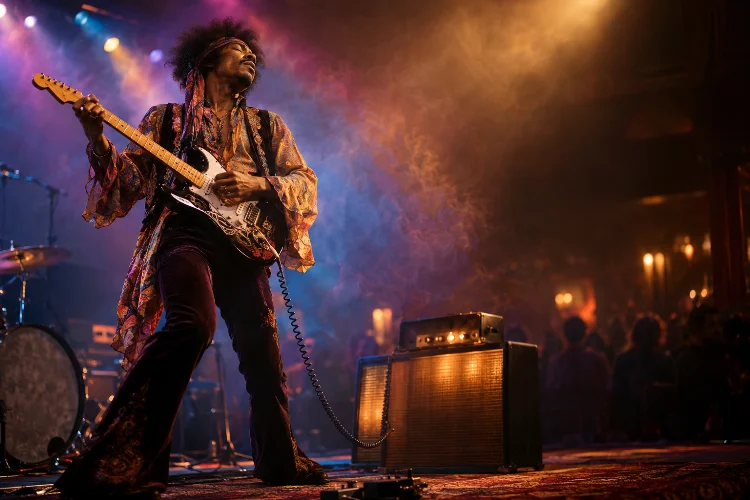
Before Jimi Hendrix, the electric guitar was already loud, expressive, and central to blues and rock. Players such as B.B. King, Chuck Berry, Buddy Guy, and Eric Clapton had demonstrated how much personality could come from six amplified strings.
Hendrix arrived and somehow made the instrument sound as though musicians had only discovered half of what it could do.
During his remarkably short mainstream career in the late 1960s, Hendrix transformed distortion, feedback, wah-wah, amplifier noise, chord voicings, and studio effects into parts of a new musical vocabulary.
The Rock & Roll Hall of Fame describes his playing as an expansion of blues through feedback, improvisation, and unusually fluid technique.
Understanding how Jimi Hendrix revolutionized electric guitar expression therefore requires looking beyond fast solos. His real innovation was broader: he blurred the line between a guitar note and pure sound.
Sometimes the instrument sang. Sometimes it screamed. Sometimes it sounded like machinery, wind, or an entire psychedelic orchestra.
Hendrix Treated Feedback as Music, Not a Mistake
Amplifier feedback existed long before Hendrix. Guitarists usually tried to control or eliminate it because uncontrolled feedback could produce loud, unpleasant tones.
Hendrix saw another possibility.
By changing his position relative to a loud amplifier, controlling guitar volume, bending strings, and manipulating effects, he could shape feedback almost like a sustained note.
This transformed something technically undesirable into an expressive tool.
The Smithsonian describes Hendrix’s approach as a brilliant manipulation of amplification and feedback that allowed him to create deeply textured, distorted soundscapes.
The important difference was control.
Hendrix did not simply make noise and hope something interesting happened. He could allow a note to bloom into feedback and then redirect it through vibrato, tremolo-arm movement, or changes in guitar position.
That approach influenced generations of experimental guitarists.
Noise was no longer automatically the opposite of music. Under the right hands, noise could become part of the composition.
Fuzz Turned Guitar Tone Into a New Kind of Voice
Hendrix also pushed distorted guitar far beyond conventional overdrive.
One of his most recognizable tools was fuzz.
Fuzz pedals aggressively reshape a guitar signal, producing a thick, compressed, almost broken tone. Earlier musicians had experimented with similar sounds, but Hendrix integrated fuzz directly into his musical personality.
“Purple Haze” is an obvious example.
The guitar does not simply sound louder than a clean instrument. Its distorted texture becomes part of the song’s psychedelic atmosphere.
The Rock & Roll Hall of Fame highlights Hendrix’s feedback-heavy psychedelic blues and tracks such as “Purple Haze” as examples of his distinctive sonic identity.
Hendrix understood that distortion changed more than tone.
It changed the behavior of the instrument.
Sustained notes lasted longer. Harmonics became more obvious. Small movements of the fingers could produce dramatic changes in texture.
This made the guitar feel less like a fixed acoustic object and more like an electrical system that could be continuously manipulated.
The Wah-Wah Pedal Made Guitar Phrasing More Vocal
Another important part of Hendrix’s sound was the wah-wah pedal.
A wah pedal changes the guitar’s frequency emphasis as the musician moves the pedal with a foot. The resulting sound resembles the changing shape of a human vowel—almost like the instrument is saying “wah.”
Hendrix made that effect deeply expressive.
Rather than moving the pedal mechanically on every beat, he could synchronize it with individual notes, phrases, and rhythmic accents.
“Voodoo Child (Slight Return)” remains one of the clearest examples.
The opening guitar seems to speak before the full riff takes over.
The Smithsonian notes that Hendrix was a master of manipulating the Stratocaster through methods including feedback and accessories such as the wah-wah pedal.
This became enormously influencial.
Later funk, hard-rock, psychedelic, and metal guitarists adopted wah not merely as an effect but as an extension of phrasing.
Hendrix had shown that electronics could become part of a player’s touch.
His Chord Playing Changed the Role of Rhythm Guitar
Hendrix is remembered as a spectacular lead guitarist, but focusing only on his solos misses one of his greatest strengths.
He was also an extraordinary rhythm player.
Instead of separating rhythm and lead into completely different roles, Hendrix often combined them. He might hold part of a chord with his thumb, play melodic decorations with his other fingers, add hammer-ons, and then move directly into a single-note phrase.
“Little Wing” demonstrates this beautifully.
The guitar simultaneously suggests chords, bass movement, melody, and small improvisational fills.
This created a much richer texture than simply strumming standard chord shapes.
His approach owed something to R&B and soul guitarists, including Curtis Mayfield, while blues remained central to his vocabulary. The Rock Hall lists Mayfield, B.B. King, Muddy Waters, Chuck Berry, and others among the musicians connected to Hendrix’s musical foundations.
The result changed rhythm-guitar vocabulary.
Countless later players adopted Hendrix-style chord embellishments because they allow one guitarist to fill much more musical space.
A Flipped Stratocaster Became Part of His Sound
Hendrix was left-handed, but he became famous for playing right-handed Fender Stratocasters flipped upside down and restrung for left-handed use.
That choice created an instantly recognizable visual image.
It also subtly changed the instrument.
Because the guitar was reversed, string lengths relative to the headstock were different from a conventional setup, and the pickup orientation was reversed. Fender notes that this arrangement affected playing feel and contributed to distinctive response characteristics.
More importantly, Hendrix exploited nearly every feature the Stratocaster offered.
Its three pickups gave him different tonal options. Volume and tone controls could be manipulated during performance, while the tremolo arm allowed dramatic pitch movement.
The Smithsonian identifies Hendrix as one of the great masters of treating the electric guitar itself as something to manipulate creatively rather than simply play conventionally.
His relationship with the Stratocaster became so iconic that the instrument and musician remain almost inseperable in popular culture.
The Tremolo Arm Became an Expressive Device
The Stratocaster’s tremolo arm was originally designed to create controlled pitch movement.
Hendrix pushed it much further.
He could make notes wobble gently, dive dramatically downward, or create unstable sound effects that seemed to melt the pitch itself.
These techniques became particularly effective when combined with distortion and feedback.
A heavily amplified note could sustain while Hendrix manipulated its pitch, causing the guitar to sound almost electronic.
This anticipated later techniques such as the dramatic “dive bombs” associated with hard rock and metal guitarists.
The Smithsonian notes that players such as Eddie Van Halen later pushed tremolo techniques further with improved hardware, building on possibilities Hendrix had already explored.
Again, Hendrix’s innovation was conceptual.
Hardware that had been designed as a relatively simple accessory became part of emotional expression.
Nothing on the instrument seemed permanently assigned to one purpose.
Hendrix Turned the Recording Studio Into Another Instrument
Hendrix’s revolution did not happen only on stage.
He became increasingly adventurous inside the recording studio.
The Jimi Hendrix Experience used techniques such as stereo panning, phasing, reversed sounds, layered guitars, and experimental tape manipulation.
The Rock & Roll Hall of Fame specifically highlights panning, backmasking, and phasing among the studio methods used as Hendrix expanded his psychedelic sound.
Electric Ladyland pushed this philosophy especially far.
Instead of treating recording as a process for accurately documenting a live performance, Hendrix approached the studio as somewhere completely new sounds could be built.
A guitar part could be layered.
Another could move across the stereo field. Effects could transform an ordinary note into a texture that could not easily exist in an untreated live performance.
His appetite for studio experiementation eventually led to Electric Lady Studios in New York, a facility designed with his creative ambitions in mind. Official Hendrix archives document his continued recording work as the studio approached completion in 1970.
Modern guitar production owes a great deal to this mindset.
Woodstock Showed That Guitar Could Communicate Beyond Words
Hendrix’s performance of “The Star-Spangled Banner” at Woodstock in August 1969 remains one of the strongest examples of guitar used as expressive sound rather than conventional melody.
He began with the familiar anthem but gradually transformed it.
Distortion, feedback, pitch bends, sustained notes, and violent tremolo-arm movements produced sounds that listeners have interpreted in many ways, including as evocations of sirens, explosions, and wartime chaos.
Fender’s account of the Woodstock guitar notes that Hendrix moved from free-form improvisation into his distorted interpretation of the anthem using his famous Olympic White Stratocaster.
What made the performance powerful was that much of its meaning came without lyrics.
The guitar itself carried the emotional message.
This demonstrated something fundamental about Hendrix’s contribution: electric guitar expression could move beyond notes, scales, and chords into sound painting.
Tone itself could communicate an idea.
His Stage Performance Changed the Image of the Guitar Hero
Hendrix was not simply innovative sonically.
He changed how audiences imagined a guitarist on stage.
He famously played behind his back and with his teeth, interacted physically with amplifiers, and at Monterey Pop in 1967 ended “Wild Thing” by setting his guitar on fire.
The Smithsonian describes the Monterey performance as career-making and emphasizes both his radical sound and theatrical presence.
The spectacle could easily have overshadowed the musicianship.
Instead, the two worked together.
Hendrix made the electric guitar look unpredictable because he made it sound unpredictable.
Later generations of guitar heroes – from hard rock and metal players to experimental musicians – adopted the idea that visual performance could become an extension of instrumental expression.
The guitarist was no longer necessarily a musician standing quietly beside the singer.
The guitarist could be the event.
Hendrix Expanded the Vocabulary for Everyone Who Followed
Perhaps Hendrix’s greatest achievement was not inventing one particular technique.
It was combining many existing and emerging ideas into an entirely new musical language.
Blues bends, R&B rhythm playing, fuzz, feedback, wah-wah, tremolo manipulation, extended improvisation, studio processing, and unusual chord voicings all became parts of one integrated style.
That integration mattered.
A player could imitate one Hendrix trick without sounding anything like Hendrix because his identity came from how the elements interacted.
His influence crossed musical genres as well.
The Rock & Roll Hall of Fame connects his legacy with later artists ranging from Prince and Stevie Ray Vaughan to Red Hot Chili Peppers and Rage Against the Machine.
Hard rock borrowed his distortion. Funk guitarists expanded his rhythmic ideas. Metal embraced his heaviness and sonic extremity, while alternative and experimental musicians continued exploring his attitude toward noise.
The tecnology changed.
The central philosophy did not: an electric guitar can sound like almost anything if a musician stops treating its conventional limitations as rules.
Jimi Hendrix revolutionized electric guitar expression because he expanded the instrument on every level. Feedback became musical, fuzz became emotional, wah-wah became vocal, rhythm and lead merged together, and the studio became another creative instrument.
Performances such as “Purple Haze,” “Little Wing,” “Voodoo Child (Slight Return),” and his Woodstock anthem reveal different parts of that revolution.
Hendrix was not simply playing more notes than everyone else. He was redefining what counted as a guitar sound in the first place.
To understand his impact, listen beyond the solos. Focus on his chord work, amplifier interaction, dynamic control, effects, and use of silence and noise. That is where Hendrix’s biggest innovation becomes clear: he turned electricity itself into a form of musical expression.