Some guitarists become famous because they master the vocabulary that already exists. Eddie Van Halen did something different: he made an entire generation of players rethink what their hands, guitars, amplifiers, and effects could actually do.
When Van Halen’s debut album appeared in 1978, the short instrumental “Eruption” sounded almost impossible to many listeners.
Rapid two-hand tapping, harmonics, aggressive tremolo work, fluid legato, and an explosive distorted tone arrived in less than two minutes. Suddenly, guitarists everywhere wanted to understand how he was producing those sounds.
Yet Eddie Van Halen’s influence on modern rock guitar techniques extends far beyond tapping. He experimented with instrument construction, pickups, amplifier response, rhythm playing, harmonics, effects, and stage technique.
The Smithsonian describes him as a self-taught innovator in both guitar technology and performance who helped musicians create sounds in new ways.
His real breakthrough was not one trick. It was treating the electric guitar as an instrument that could always be redesigned, physically and musically.
“Eruption” Changed Expectations for Rock Guitar
Van Halen’s 1978 debut introduced mainstream audiences to one of rock guitar’s most famous instrumental showcases.
“Eruption” was surprisingly spontaneous.
Eddie later explained that he was warming up in the studio when producer Ted Templeman heard him and decided the performance should be recorded.
According to Van Halen, the version released on the album was essentially a single take – and he even remembered making a mistake in it.
That imperfection did not matter.
What listeners heard was speed, control, unusual articulation, harmonics, tremolo effects, and a flowing technique that made the guitar sound almost synthesizer-like at moments.
The track changed the standard for aspiring rock guitarists.
After “Eruption,” technique itself became a major part of rock-guitar culture. Players increasingly studied fingerboard mechanics, amplifier tone, custom instruments, and advanced solo techniques.
A guitar solo could now be an event in its own right.
Two-Hand Tapping Became a Mainstream Guitar Language
Eddie Van Halen did not claim to have invented tapping.
Variations of tapping and hammer-on techniques existed before him. What he did was develop the technique into an integrated musical system and expose it to a massive rock audience.
Van Halen explained that he developed his own approach after seeing Jimmy Page use hammer-on and pull-off ideas onstage. He realized that placing his picking hand on the fretboard would allow him to extend those patterns across a much wider range.
That simple idea created enormous possibilities.
Both hands could now produce notes directly on the fretboard. Wide interval jumps became easier, rapid arpeggio-like figures could flow smoothly, and phrases that would be awkward with conventional picking suddenly became practical.
The important point is that Eddie viewed tapping as musical vocabulary rather than a circus trick.
He later criticized players who copied the surface-level technique without using it expressively, saying his own technical ideas were meant to tell a musical story.
That distinction explains why his influence lasted.
Harmonics Became More Than Decorative Effects
Van Halen also transformed the way rock guitarists approached harmonics.
Natural harmonics had been used long before him, but Eddie mixed natural, artificial, and tapped harmonics into riffs and solos with remarkable freedom.
The result could sound almost bell-like.
By lightly touching specific points of a vibrating string, guitarists can expose higher overtones rather than the fundamental note. Van Halen learned how to combine those sounds with gain, tremolo movement, and tapping.
This expanded the guitar’s sonic range.
Harmonics were no longer simply little effects inserted between normal phrases. They could become melodic accents, screaming peaks, or rhythmic punctuation.
His use of artificial harmonics also encouraged later hard rock and metal guitarists to explore increasingly dramatic high-frequency sounds.
Today these techniques are so common that they can seem ordinary.
That familiarity is partly evidence of how influencial his playing became.
The Whammy Bar Became a Tool for Controlled Chaos
Before Eddie Van Halen, tremolo arms were already widely used for vibrato and pitch effects.
Eddie pushed them into extreme territory.
He could drop the pitch dramatically, make notes dive downward, create siren-like sounds, and then return surprisingly close to pitch. These techniques eventually became known broadly as dive bombs.
The challenge was tuning stability.
Traditional tremolo systems could easily knock strings out of tune when manipulated aggressively. The development and widespread adoption of locking tremolo systems helped make extreme pitch effects more practical.
Van Halen made this style of playing culturally irresistible.
After him, players associated with hard rock and heavy metal increasingly treated the tremolo bar as an expressive control rather than an occasional effect.
A note did not have to remain at one pitch.
It could fall, shake, scream, and recover.
That changed the physical vocabulary of lead guitar almost as dramatically as tapping.
Frankenstrat Changed How Guitarists Thought About Instruments
Eddie was not satisfied with the guitars available to him.
So he built one.
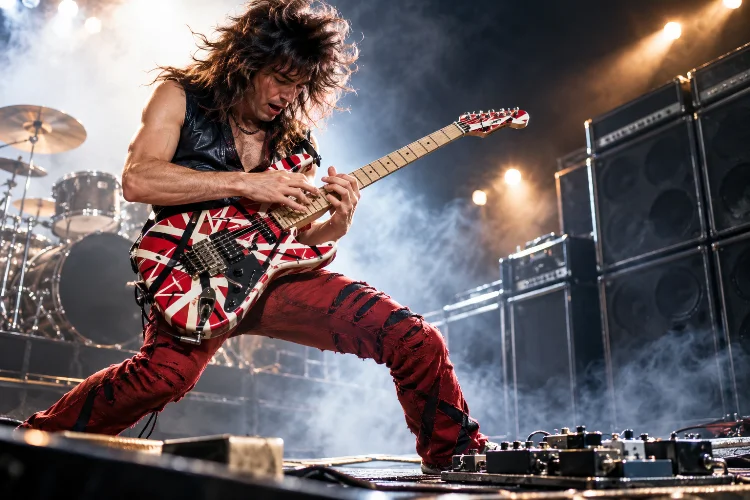
The instrument eventually known as Frankenstein, Frankenstrat, or Frankie combined characteristics that musicians normally associated with different guitar designs.
The Smithsonian notes that Van Halen concluded in the mid-1970s that existing guitars did not provide everything he wanted, leading him to construct an instrument around his own playing requirements.
That philosophy became incredibly important.
Instead of adapting his playing to an instrument, Eddie adapted the instrument to his playing.
The Frankenstein concept combined the comfortable, tremolo-equipped feel associated with Strat-style guitars with the powerful humbucking sound preferred for heavier rock.
That basic combination helped inspire what became known as the Superstrat.
By the 1980s, high-output pickups, locking tremolos, custom necks, and modified Strat-style bodies had become standard features across the rock-guitar market.
Eddie’s do-it-yourself experimantation helped reshape the guitar industry.
His Rhythm Playing Was Just as Innovative
The technical spectacle sometimes hides another truth: Eddie Van Halen was an exceptional rhythm guitarist.
Listen carefully to songs such as “Ain’t Talkin’ ‘Bout Love,” “Panama,” or “Unchained.”
The guitar does much more than play simple power chords.
Eddie mixed riffs with muted strings, harmonics, chord fragments, syncopated accents, open strings, and short lead fills. The transitions between rhythm and lead could happen almost instantly.
This gave Van Halen a huge sound despite the classic lineup having only one guitarist.
His timing with drummer Alex Van Halen was especially important.
The brothers created grooves that could feel heavy without becoming mechanically rigid. Eddie frequently left small rhythmic gaps for bass, drums, or vocals rather than filling every available space.
That made his playing breathe.
For modern guitarists, his rhythm work may actually offer more practical lessons than his fastest solos.
Eddie Changed the Idea of “Brown Sound”
Technique was only half the equation.
Tone mattered enormously.
Eddie became associated with the famous “brown sound,” a warm but aggressive distorted tone with clarity, sustain, and strong harmonic content.
Players have spent decades attempting to recreate it.
But his sound was not simply the result of one expensive amplifier or mysterious effect. Guitar construction, pickups, amplifier settings, speaker behavior, effects, playing touch, and recording technique all contributed.
That holistic approach became extremely influencial.
Guitarists increasingly began treating the entire signal chain as part of their instrument.
The pickup mattered. The amplifier mattered. Speaker response mattered. Effects placement mattered.
Most importantly, the player’s hands still mattered.
This mindset helped establish modern guitar-tone culture, where musicians experiment endlessly with equipment to create a personal sonic identity rather than accepting factory settings.
Effects Became Part of the Performance
Van Halen also used effects in unusually musical ways.
Phasing became particularly associated with early recordings. Rather than completely transforming the guitar, the moving filter created motion around riffs.
Delay could make solos wider.
Flanging produced more dramatic sweeping textures, while amplifier saturation provided the foundation underneath everything.
Eddie rarely sounded as though he were simply switching on an effect for novelty.
The effect interacted with the musical phrase.
This is an important difference.
Modern guitar rigs may contain dozens of digital effects, but Eddie’s approach demonstrates that interesting gear does not automatically create interesting music.
The effect should support the riff.
That philosophy helped establish the idea that pedals and signal processors could become part of composition rather than merely studio decoration.
Technique Served Personality, Not Perfection
One reason Eddie’s playing remains exciting is that it rarely sounds clinically perfect.
There is attack, noise, string movement, pick scrape, amplifier saturation, and physical energy.
His playing feels performed.
This distinguishes him from the image of technical guitar as something cold or mathematical.
Even extremely difficult phrases often contain a strong sense of rhythm and humor.
Van Halen himself emphasized that techniques such as tapping and false harmonics mattered because they were part of expression rather than isolated tricks.
This may be one of his most valuable lessons.
Technique is vocabulary.
Knowing more vocabulary gives musicians more ways to communicate, but vocabulary alone does not produce a meaningful sentence.
Eddie developed spectacular tools and then gave them personality.
His Influence Created an Entire Generation of Guitar Players
After Van Halen became successful, rock guitar changed rapidly.
Two-hand tapping spread everywhere. High-output pickups and modified Strat-style guitars became enormously popular. Extreme tremolo techniques became expected within hard rock, while players increasingly pursued faster legato runs and harmonics.
Some musicians copied Eddie almost directly.
Others took individual ideas and moved them in different directions.
The Smithsonian describes him as one of the most emulated guitarists of his generation, while preserving a replica of Frankenstein as an object representing both musical and technological innovation.
The broader influence remains visible today.
Modern rock and metal players routinely use techniques that might have seemed revolutionary in 1978: fretboard tapping, extreme pitch manipulation, custom pickup configurations, complex harmonics, and highly personalized guitar designs.
What once sounded shocking eventually became vocabulary.
That may be the clearest measure of Eddie Van Halen’s impact.
Eddie Van Halen transformed modern rock guitar because he refused to separate technique, tone, and instrument design.
Two-hand tapping, harmonics, extreme tremolo work, powerful rhythm playing, effects, and the Frankenstein guitar all came from the same curiosity: what else could the electric guitar do?
“Eruption” made the revolution impossible to ignore, but his deeper influence can be heard across Van Halen’s riffs, rhythm parts, solos, and equipment experiments.
For guitarists, the best lesson is not to copy every Eddie trick. Instead, copy his curiosity. Take one familiar technique, sound, or piece of gear and ask how it could work differently.
Eddie Van Halen’s greatest contribution was showing that the rules of electric guitar were never as permanent as they seemed.