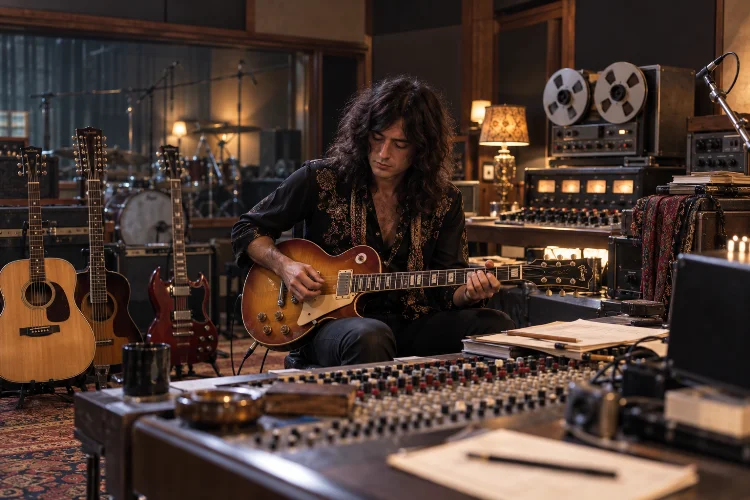
Led Zeppelin often sounded far bigger than a four-piece band. John Bonham’s drums and John Paul Jones’ bass certainly contributed to that enormous scale, but much of the band’s studio depth came from Jimmy Page’s unusual approach to arranging guitars.
Page rarely treated overdubbing as a simple way to make one guitar louder. Instead, he gave different guitar parts specific jobs.
A six-string acoustic might establish the harmonic foundation, a 12-string could add shimmer, an electric guitar might reinforce selected notes, while another track supplied a melodic response or solo.
That philosophy became central to how Jimmy Page developed layered guitar arrangements for rock.
His background as a British session guitarist gave him experience with microphones, double-tracking, studio discipline, and arrangement long before Led Zeppelin became famous.
Page has said that double-tracking was already part of the band’s first album and that he wanted Zeppelin recordings to use the full stereo picture.
The result was a production style where guitars behaved almost like sections of an orchestra rather than copies of one instrument.
Session Work Taught Page to Think Like an Arranger
Before Led Zeppelin, Page spent years working as a session guitarist in London.
That environment required flexibility. A studio musician might have to create a useful part quickly, understand how it interacted with other instruments, and avoid filling frequencies already occupied by vocals, piano, or another guitar.
Those skills became extremely useful later.
Instead of thinking only like a lead guitarist, Page approached recordings as a producer. Led Zeppelin’s official historical material identifies him not only as the band’s lead guitarist but also as the producer of its recordings.
That distinction matters.
A guitarist naturally asks, “What should I play?”
A producer asks, “What does the entire recording need?”
Page could therefore remove a guitar when space was more powerful, add another only when the arrangement required more weight, or choose an acoustic instrument instead of automatically reaching for distortion.
That wider perspective shaped Zeppelin’s studio identity.
Double-Tracking Created Width Without Losing Definition
One of Page’s fundamental techniques was double-tracking.
Rather than simply copying a recorded track electronically, a musician performs the same or similar part again. Tiny differences in timing, attack, and tuning create natural width when the two performances are placed across the stereo field.
Page has specifically recalled using double-tracking as early as Led Zeppelin’s first album, mentioning “Good Times Bad Times” as a likely example. He had already used the technique during his session years.
But doubling was not always about playing exactly the same thing.
The second guitar could use another register, voicing, or tone.
That kept arrangements from becoming muddy.
This is one reason Page’s recordings can contain multiple guitars without always sounding crowded. The parts often occupy slightly different musical spaces.
For modern guitarists, that remains a valuable production lesson: adding more tracks works best when every new layer has a reason to exist.
Stairway to Heaven Demonstrated Gradual Layer Building
“Stairway to Heaven” offers one of the clearest examples of Page’s arrangement philosophy.
The recording begins delicately before expanding in stages.
Page has explained that he envisioned the piece with acoustic guitars, 12-string textures, layered parts, and a six-string solo. The arrangement created such a complex studio problem that reproducing it live eventually required his famous Gibson EDS-1275 double-neck guitar.
This gradual accumulation is crucial.
Instead of starting with the entire band at maximum intensity, Page leaves room for new elements to arrive.
The listener therefore feels the song physically growing.
A brighter 12-string texture strengthens the acoustic foundation before the rhythm section eventually increases the weight. The final electric solo then feels important because the arrangement has spent several minutes creating space for it.
This is layered production used as storytelling.
The arrangment is not merely thicker at the end – it has travelled somewhere.
Acoustic and Electric Guitars Could Share the Same Arrangement
Page never treated acoustic guitar as a softer substitute for electric guitar.
It had its own structural function.
Led Zeppelin III made that especially obvious, but acoustic-electric combinations continued throughout the band’s catalog. Acoustic strings could provide attack and rhythmic clarity while electric parts added sustain, atmosphere, or power.
When these textures overlap, they create contrast.
An acoustic guitar has a fast transient: you hear the pick or fingers hitting the strings immediately. An overdriven electric guitar can sustain much longer.
Combining those characteristics makes an arrangement feel detailed without necessarily increasing volume.
“Stairway to Heaven” demonstrates the idea clearly, while other Zeppelin recordings move between folk-oriented passages and heavy amplification with little concern for genre boundaries.
Page’s approach helped normalize that contrast within hard rock.
A heavy band did not need to sound heavy every second.
Sometimes the acoustic section makes the electric section seem even larger.
Alternate Tunings Created Layers That Standard Tuning Could Not
Another important part of Page’s arranging vocabulary was alternate tuning.
Changing the tuning of the strings alters available chord shapes, open-string resonance, and the way notes interact.
“Kashmir” is a famous example.
Page used DADGAD, a tuning strongly associated with folk guitar traditions, to build the track’s cyclical riff.
Sound On Sound’s detailed history of the recording notes that Page and John Bonham developed the basic idea together, with Page later adding overdubs that were reinforced by orchestral arrangements.
The tuning contributes to the track’s unusual character because open strings continue ringing around moving chord shapes.
Those sustained notes function almost like a drone.
That makes the guitar sound wider than a standard riff built from tightly fretted power chords.
John Paul Jones’ orchestration then expands the same musical identity instead of simply decorating it.
The lesson is important: layering does not always require more notes.
Sometimes changing tuning creates harmonic depth before overdubbing even begins.
Page Used Different Guitar Parts Instead of One Giant Wall
Page’s layered recordings usually maintain a surprising amount of seperation.
Why?
Because the parts often do different things.
One guitar may play chords while another supplies a counterline. A third might appear only at the end of a phrase. Another could be recorded with a different tone so listeners unconsciously distinguish it from the surrounding instruments.
This is orchestral thinking.
Violins, cellos, and brass do not necessarily play identical notes simply because they belong to the same orchestra. Each section contributes something specific.
Page applied a similar concept to guitar.
His comments about recording Houses of the Holy show how deeply he was exploring this approach.
He had installed a home multitrack setup and used it to experiment with arrangements, including developing “The Rain Song” in demo form because its larger musical design was difficult to communicate with one guitar alone.
Multitracking became a compositional tool rather than an afterthought.
The Song Remains the Same Showed How Layers Could Become Motion
“The Song Remains the Same” demonstrates another Page technique: using several bright guitar parts to create movement.
Rather than building everything around one huge distorted riff, the arrangement includes fast, chiming guitar textures that interact across different registers.
The result feels almost constantly in motion.
Page also thought carefully about how studio arrangements might translate to live performance.
He later explained that the double-neck guitar became useful not only for “Stairway to Heaven” but also for material from Houses of the Holy, including “The Song Remains the Same” and “The Rain Song.”
This highlights the difference between studio and stage.
In the studio, one musician can record several guitars.
Onstage, Page had to decide which parts were essential enough to reproduce physically.
That limitation reveals something useful about his arrangements: even complicated recordings generally contained a clear hierarchy.
Not every overdub was equally important.
Spatial Recording Made Guitars Feel Three-Dimensional
Page’s production philosophy also involved depth.
A guitar can sound close or distant depending on microphone position, ambience, echo, and how it is placed in the stereo image.
Page understood that apparent distance could be part of the arrangement.
Instead of recording every instrument as close and dry as possible, Led Zeppelin productions often allowed the surrounding room to become audible.
This was particularly important for the band’s drums, but the broader principle applied throughout Page’s production approach: instruments should occupy a physical environment.
He has described wanting a “full stereo picture” and intentionally thinking about where instruments should sit within it.
That philosophy prevents dense arrangements from collapsing into one flat block of sound.
One guitar might appear close and focused while another feels wider or more ambient.
The listener perceives depth even without consciously identifying why.
Page was layering space as much as he was layering guitars.
Spontaneous Performances Kept Dense Arrangements Alive
Layering can easily become too perfect.
If every guitar part is edited and repeated identically, an arrangement can lose the loose energy that makes rock exciting.
Page often avoided that problem by keeping a degree of spontaneity.
Discussing “Dancing Days,” he recalled recording a loud slide part with the amplifier out in the studio while he played from the control room. He had not completely predetermined the part, and after recording it he double-tracked it.
That combination is revealing.
There was production planning, but there was also instinct.
Similarly, Page has described recording solos after other overdubs were completed, allowing him to react to the finished arrangment. His “Stairway to Heaven” solo was largely improvised rather than written note by note.
This kept the studio from becoming purely mechanical.
Structure created the frame; spontaneous playing supplied personality.
Kashmir Proved Layering Could Extend Beyond Guitar
Perhaps Page’s most sophisticated lesson was that a layered guitar arrangement did not necessarily require every layer to remain a guitar.
“Kashmir” illustrates this brilliantly.
Page created the core guitar material, but orchestration later reinforced and expanded those ideas. He recalled that the overdubs were duplicated by an orchestra, increasing the track’s ominous scale.
Instead of fighting the orchestra for attention, the guitar riff provides a foundation the larger arrangement can inhabit.
This reflects Page’s producer mindset again.
The goal was not to make the guitar dominate every frequency.
The goal was to build a specific atmosphere.
Modern rock producers use the same principle with synthesizers, strings, processed guitars, and samples. A guitar-written idea can be doubled by completely different textures to create size without requiring endless copies of the same instrument.
That approach helped make Zeppelin recordings feel cinematic long before cinematic rock became a familiar label.
Jimmy Page’s Layering Became a Blueprint for Modern Rock Production
The influence of Page’s production style extends well beyond classic rock.
Modern rock recordings routinely use double-tracked rhythm guitars, contrasting acoustic layers, alternate tunings, stereo placement, multiple amplifier tones, and carefully arranged overdubs.
The technology is easier now.
A guitarist can record dozens of tracks on a laptop, edit timing precisely, and experiment with unlimited virtual amplifiers.
But unlimited tracks do not automatically produce a powerful arrangement.
Page’s work suggests almost the opposite.
Good layering depends on contrast, dynamics, musical roles, and knowing when not to add another guitar.
That may be the most practical lesson from his production style.
A large sound is not necessarily created by recording twenty copies of the same riff.
It can come from two or three carefully chosen parts that occupy different spaces and work together.
The experimantation matters, but so does restraint.
Jimmy Page developed layered guitar arrangements by thinking beyond the traditional roles of lead and rhythm guitar.
He used double-tracking, acoustic-electric contrast, 12-string textures, alternate tunings, stereo placement, room ambience, and overdubs that complemented rather than duplicated one another.
Tracks such as “Stairway to Heaven,” “The Rain Song,” “The Song Remains the Same,” and “Kashmir” show how those techniques could create scale while preserving clarity and dynamics.
For guitarists and producers, Page’s biggest lesson remains surprisingly modern: do not add a layer simply because another track is available. Give every guitar a purpose.
Listen to classic Zeppelin recordings with headphones and follow each part separately – you may discover that their huge sound is built from far more precision and restraint than it first appears.