For decades, popular songwriting followed a reliable formula: verse, chorus, another verse, another chorus, perhaps a bridge, and then a final hook.
It worked because listeners could understand the structure almost immediately. Then progressive rock musicians started asking a different question: why should a rock song follow any formula at all?
Beginning in the late 1960s and flourishing through the 1970s, progressive rock – or prog rock – treated songwriting more like architecture than simple pop construction.
Bands such as King Crimson, Yes, Genesis, and Pink Floyd experimented with extended compositions, unusual time signatures, classical influences, instrumental passages, and album-length concepts.
The Rock & Roll Hall of Fame describes progressive rock as a movement that expanded rock through ideas such as classical suite structures, virtuosic musicianship, concept albums, and new keyboard technology.
Understanding how progressive rock redefined traditional songwriting structures therefore means looking at more than long songs. Prog changed the basic idea of what a rock composition could contain, how it could develop, and how listeners experienced an album.
Progressive Rock Moved Beyond Verse-Chorus Songwriting
Traditional pop songs usually depend on repetition.
A verse establishes the story, the chorus delivers the main hook, and both return several times. Progressive rock musicians often kept some of those elements, but they stopped treating them as mandatory.
Instead, a composition might introduce a musical theme once, transform it, move into an instrumental section, change tempo, introduce another melody, and never return to the original idea in exactly the same form.
This approach made songs feel like journeys rather than repeating cycles.
Yes became particularly associated with this compositonal freedom. The Rock & Roll Hall of Fame describes the band as creating complex and virtuosic rock suites influenced by everything from psychedelic music to classical composition.
Songs could still contain memorable melodies, but listeners could no longer predict exactly where those melodies would lead.
That unpredictability became part of prog’s appeal.
Long-Form Songs Turned Rock Into Musical Journeys
One of the most obvious progressive rock innovations was song length.
Radio-friendly singles often lasted only a few minutes. Progressive bands frequently wrote compositions lasting ten, fifteen, or even twenty minutes.
Length alone did not make a song progressive. The important difference was what musicians did with the additional space.
Long tracks allowed composers to introduce several sections, develop instrumental themes, shift mood, and gradually build toward dramatic peaks.
A song could move from quiet acoustic passages into synthesizer-driven sections before ending with an enormous electric-guitar climax.
Yes frequently structured songs as mini-suites rather than conventional standalone pop tunes, combining complicated meters with folk and classical influences.
Genesis followed a similar philosophy during its early period.
Rather than writing around a single chorus, the band could construct pieces around characters, changing scenes, instrumental interludes, and evolving musical motifs.
The result was closer to storytelling through composition.
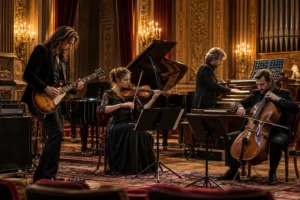
Suites Borrowed Ideas From Classical Music
Progressive rock musicians were fascinated by classical forms.
One particularly important influence was the suite—a larger musical work divided into multiple connected sections.
Prog bands adapted this principle to rock.
Instead of writing several completely separate songs, musicians could connect sections through recurring melodies, shared themes, transitions, or narrative ideas. Individual movements might sound different while still belonging to the same larger composition.
The Rock Hall’s overview of progressive rock specifically identifies European classical structures such as suites as one of the genre’s defining innovations.
This opened enormous songwriting possibilities.
A soft piano passage could function as an introduction. A guitar-heavy section might increase tension. An instrumental movement could explore the main musical theme before vocals returned in a completely different setting.
Importantly, progressive musicians were not simply copying classical composers.
They were translating classical concepts into amplified rock arrangements involving electric guitar, bass, drums, organ, Mellotron, and synthesizers.
That combination produced something distinctly modern.
Odd Time Signatures Changed the Rhythmic Rules
Most mainstream rock is built around 4/4 time because it creates an easy, steady pulse.
Progressive rock musicians were rarely satisfied with staying there.
Songs could move into 5/4, 7/8, 9/8, or even switch repeatedly between different meters. These changes made the rhythm feel less predictable and allowed instrumental parts to interact in unusual ways.
Yes became famous for shifting between complicated time signatures, while other progressive groups made rhythmic complexity an essential part of their identity.
The important point is that odd meters were not always used simply to show technical skill.
They could support the emotional character of a section.
An uneven rhythm might create tension or instability. Returning suddenly to straightforward 4/4 could then feel surprisingly powerful.
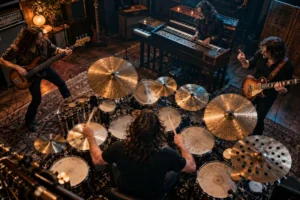
Progressive drummers also became more active within arrangements. Instead of simply maintaining the beat, performers such as Bill Bruford treated drums almost like melodic instruments.
This changed the entire rythmical relationship between instruments.
Songs Began Using Recurring Themes and Reprises
Progressive rock composers also borrowed another technique common in larger classical works: recurring musical themes.
A melody introduced near the beginning of a composition could disappear for several minutes and return near the end in a transformed form.
This is often called a reprise.
The returning section creates familiarity while giving listeners a sense that the composition has travelled somewhere.
Maybe the melody first appears quietly on acoustic guitar. Later, it returns with drums, electric guitar, synthesizers, and layered vocals. The notes may be recognizable, but their emotional meaning has changed.
This technique allowed prog musicians to create unity across extremely long pieces.
It also rewarded repeated listening.
Someone hearing an album for the first time might simply notice an attractive melody. After several listens, they may begin recognizing how that motif connects different sections.
Prog therefore encouraged a kind of active listening that differed from casually hearing individual singles.
Concept Albums Expanded Songwriting Beyond Individual Tracks
Perhaps the most ambitious progressive rock innovation was the concept album.
Instead of treating each song as an independent composition, musicians could design an entire album around one story, character, emotional journey, or central idea.
AllMusic identifies album-based composition as a defining part of prog, noting that many bands created concept records built around unified narratives or broad themes.
Pink Floyd became particularly important in pushing this format toward mainstream audiences.
Albums such as The Dark Side of the Moon used interconnected themes, sound effects, recurring musical ideas, and transitions that encouraged listeners to experience the record from beginning to end.
The Rock & Roll Hall of Fame highlights Pink Floyd’s movement from psychedelic singles toward melodic jams and concept albums.
That approach changed the meaning of songwriting.
The basic creative unit was no longer necessarily the three-minute song.
It could be the entire album.
Instrumental Sections Became Part of the Story
Traditional pop songwriting usually keeps vocals at the center.
Prog often allowed instruments to carry the narrative instead.
Extended keyboard, guitar, bass, and drum sections could develop musical ideas without any lyrics. These passages were not always conventional solos performed over an unchanged backing progression.
Instead, the whole band might move through multiple coordinated sections.
A synthesizer melody could introduce an idea, bass might transform it, and guitar could eventually carry it into a completely different harmonic environment.
This required high levels of musicianship, one reason virtuosity became strongly associated with progressive rock.
AllMusic notes that the genre frequently favored complex, multi-section compositions and instrumental technique influenced by classical traditions.
The songwriter’s role therefore expanded.
Writing a prog song could mean designing interactions between several instruments rather than simply creating chords underneath a vocal melody.
Technology Became Part of Song Structure
Progressive rock’s structural experiments were also connected to new technology.
The late 1960s and 1970s brought musicians increasingly sophisticated studio equipment, synthesizers, Mellotrons, electric keyboards, multitrack recording, and effects processors.
These tools did more than change tone.
They changed composition.
A synthesizer could introduce textures impossible to reproduce with conventional guitar, bass, and drums. Multitrack recording allowed bands to layer voices and instruments into arrangements that would have been extremely difficult to capture live.
Progressive rock was also one of the first major rock movements in which synthesizers became fundamental parts of the band rather than occasional novelties.
Studio production itself became another songwriting tool.
Sound effects could connect sections. Tape experimentation could create transitions. Different sonic environments could represent changes in mood or narrative.
The studio was becoming an instrument.
Genesis Combined Storytelling With Structural Experimentation
Genesis provides a particularly useful example of how prog expanded songwriting.
During the Peter Gabriel era, the band’s compositions often combined narrative lyrics with dramatic musical shifts. Songs could introduce strange characters, change perspective, move through instrumental passages, and eventually return to earlier themes.
The Rock & Roll Hall of Fame describes Genesis as balancing boundary-pushing creativity with later commercial accessibility.
Peter Gabriel’s theatrical performances pushed the idea even further.
Characters in songs could be represented through costumes and stage acting, turning compositions into something closer to musical theatre.
This meant songwriting was no longer confined to melody and lyrics.
Music, narrative, visual presentation, and performance could all work together.
That kind of experimantation helped establish an approach later used by concept-heavy rock, progressive metal, and theatrical live performers.
Prog Proved Complex Songs Could Still Reach Large Audiences
Progressive rock was sometimes criticized for becoming overly complicated or self-indulgent.
Yet its commercial impact showed that audiences were willing to engage with unusual structures.
Yes, Genesis, and Pink Floyd all eventually reached enormous audiences despite working with ideas that challenged conventional pop songwriting. Pink Floyd’s The Dark Side of the Moon, for example, turned a unified, experimental album into one of rock’s landmark commercial successes.
This challenged the assumption that complexity automatically prevented accessibility.
A song could contain changing meters and long instrumental sections while still offering memorable melodies.
Progressive rock therefore opened a creative space between experimental composition and popular music.
Later musicians used that space in different ways.
Progressive metal bands emphasized technical complexity. Alternative groups adopted unusual structures without necessarily sounding like classic prog. Even modern cinematic rock frequently uses slow builds, recurring themes, and multi-section compositions.
The influence continued even when the original genre’s popularity changed.
Progressive Rock Changed the Meaning of a “Song”
Ultimately, progressive rock’s greatest contribution to songwriting was philosophical.
It challenged the assumption that a song needed to fit a predetermined shape.
The structure could follow the story rather than the other way around. If an idea required three minutes, the song could be three minutes. If it needed twenty, musicians could build a twenty-minute suite.
Repetition became optional.
A chorus might appear once. A melody could disappear and return much later. Lyrics could pause for an extended instrumental movement. Individual tracks could even function as chapters within a larger album.
That creative freedom became prog’s real legacy.
Not every musician wanted to write complicated epics – and punk rock would famously react against some of prog’s complexity – but the possibilities available to rock songwriters had permanently expanded.
Progressive rock redefined traditional songwriting structures by refusing to treat verse-chorus formulas as fixed rules.
Bands such as Yes, Genesis, Pink Floyd, and King Crimson showed that rock compositions could use suites, odd meters, extended instrumental passages, reprises, concept narratives, and album-wide musical themes.
Just as importantly, prog transformed the songwriter from someone constructing individual songs into someone capable of designing entire musical worlds.
Its influence can still be heard in progressive metal, alternative rock, experimental music, and concept albums today.
To experience that evolution yourself, listen to a classic prog album from beginning to end instead of jumping between tracks.
Follow the recurring melodies, rhythmic changes, transitions, and instrumental sections – you may discover that the “song” is much larger than it first appears.