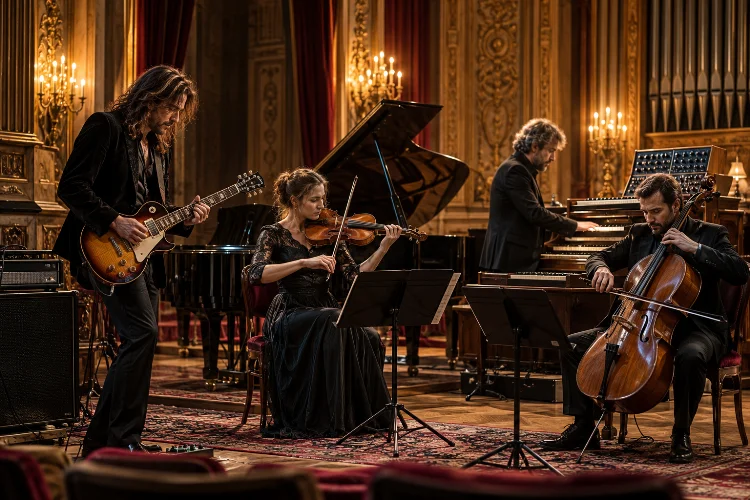
A rock song does not normally make you think of Bach, Mussorgsky, symphonic suites, or complex orchestration.
Yet during the late 1960s and 1970s, a generation of musicians began mixing exactly those ideas with electric guitars, drums, organs, and newly emerging synthesizers.
Progressive rock grew from a desire to push rock beyond the familiar three-minute single.
Groups such as Yes, Emerson, Lake & Palmer, Genesis, and King Crimson experimented with extended compositions, recurring themes, unusual harmony, instrumental virtuosity, and structures inspired partly by European classical music.
The Rock & Roll Hall of Fame describes progressive rock as a style in which musicians drew from classical forms, including suites, while expanding rock’s musical vocabulary.
Understanding how classical music influenced progressive rock composition is not simply about spotting an orchestra or hearing a keyboard imitate one.
The deeper connection appears in the way prog musicians organized, developed, and transformed musical ideas over time.
Classical Music Encouraged Longer Song Structures
Traditional pop and early rock usually depended on compact structures.
A verse introduced the lyrics, a chorus delivered the main hook, and the pattern repeated. Progressive musicians often wanted more room to develop their ideas.
Classical composition offered another model.
A symphony, concerto, or sonata could introduce a theme, transform it, move into contrasting material, and eventually bring earlier ideas back in a different form. Prog bands adopted a similar philosophy, even if they did not follow classical forms exactly.
That helped produce compositions lasting ten, fifteen, or twenty minutes.
Instead of repeating one chorus several times, a progressive track might begin acoustically, move into a keyboard passage, introduce a heavy guitar section, shift meter, and eventually return to its opening melody.
Yes became particularly associated with this approach. The Rock & Roll Hall of Fame describes the group as creating complex and virtuosic rock suites shaped partly by classical influences.
The rock song was becoming something closer to a journey.
The Classical Suite Became a Prog Rock Blueprint
One of the clearest structural connections between classical music and progressive rock is the suite.
In classical tradition, a suite combines several individual movements into a larger work. Each section can have its own mood and tempo while remaining connected to the whole.
Progressive bands loved that idea.
A long track could be divided into named sections, each introducing different musical material. Rather than forcing every idea into one conventional verse-chorus format, musicians could build a composition from contrasting movements.
This made dramatic transitions easier.
A quiet piano introduction might lead into an aggressive instrumental section. That could suddenly collapse into a vocal passage before an earlier theme returns during the finale.
Yes used extended suites extensively, while Genesis created long narrative compositions made from interconnected sections.
The structure allowed rock musicians to think on a larger scale. They were no longer writing only songs; they were designing complete musical sequences.
This compositonal freedom became one of progressive rock’s most recognizable characteristics.
Emerson, Lake & Palmer Turned Classical Works Into Rock
No major progressive band demonstrated the classical connection more openly than Emerson, Lake & Palmer.
Keith Emerson had already experimented with adapting classical material before forming ELP. With Greg Lake and Carl Palmer, he pushed the idea much further.
The band’s Pictures at an Exhibition, released in 1971, was based on Modest Mussorgsky’s famous nineteenth-century composition. ELP selected portions of Mussorgsky’s work, rearranged them for keyboards, bass, drums, and vocals, and inserted original material of their own.
This was not an orchestra politely accompanying a rock band.
The musicians treated classical material as something that could be amplified, rearranged, improvised around, and transformed into aggressive rock.
ELP also adapted music associated with composers including Béla Bartók, Leoš Janáček, Aaron Copland, and Tchaikovsky throughout their career.
That willingness to reinterpret classical works showed that progressive rock viewed the tradition less like a museum and more like raw creative material.
Counterpoint Changed How Instruments Interacted
Classical influence also appeared in the relationship between instruments.
In much conventional rock, the singer carries the melody while bass, guitar, and keyboards largely support it. Progressive musicians often created more independent instrumental lines.
This resembles the classical idea of counterpoint, where separate melodies interact simultaneously.
A guitarist might play one pattern while bass moves independently beneath it. Keyboards could introduce another line while drums emphasize accents that do not simply follow the guitar.
The result can sound extremely dense.
Yes was especially effective at making these overlapping parts feel musical. Steve Howe’s guitar, Chris Squire’s melodic bass, Rick Wakeman’s keyboards, and the band’s vocal harmonies frequently occupied different musical spaces rather than moving together as one block.
King Crimson took the idea into more experimental territory.
AllMusic describes King Crimson as stretching rock’s language and structure into areas influenced by both jazz and classical music.
For listeners, this means there is often more than one thing worth following at once.
A bass line can be nearly as interesting as the lead melody.
Classical Harmony Expanded Rock’s Emotional Palette
Early rock frequently relied on relatively straightforward blues-derived harmony.
Progressive rock widened the possibilities.
Classical music provided centuries of examples involving modulation, unusual chord movement, tension, resolution, diminished harmony, pedal tones, and shifting tonal centers.
Prog musicians used these ideas without necessarily following strict classical rules.
A section might begin in one key and slowly move somewhere unexpected. Another could use chords selected more for dramatic color than for supporting a traditional pop melody.
Keyboard instruments made this particularly easy to explore.
Organs, pianos, Mellotrons, and synthesizers could create dense chord voicings that sounded much broader than basic guitar triads.
Genesis keyboardist Tony Banks became especially associated with rich harmonic textures, while Yes frequently used chords that created an almost symphonic feeling around relatively rock-oriented instrumentation.
That harmonic complexity gave prog a wider emotional range.
Music could sound triumphant one moment, mysterious the next, and deeply unsettled only a few measures later.
Recurring Motifs Created Musical Unity
Classical composers often use motifs—short musical ideas that return throughout a larger work.
Progressive rock adopted this strategy enthusiastically.
A melody might appear near the beginning of a twenty-minute composition, disappear during several completely different sections, and return near the end.
The repetition gives listeners a sense of recognition.
But the returning theme does not have to sound identical. Musicians can change its instrumentation, tempo, harmony, or intensity.
Imagine a melody first played quietly on acoustic guitar.
Twenty minutes later, the same notes return with electric guitar, Mellotron, drums, bass, and layered vocals. The melody is familiar, but its emotional effect has completely changed.
This type of thematic development helped long progressive tracks avoid feeling like random collections of ideas.
It gave them structure.
The technique also made repeated listening rewarding because listeners gradually discovered connections they might have missed the first time.
Classical Virtuosity Changed Expectations for Rock Musicians
Progressive rock also borrowed something less obvious from the classical world: the idea of the virtuoso performer.
Classical concert traditions often celebrate musicians capable of mastering technically demanding material. Prog brought a similar expectation into rock.
Keyboard players such as Keith Emerson and Rick Wakeman became major attractions rather than background accompanists.
Guitarists, bassists, and drummers also tackled increasingly demanding arrangements.
Yes is described by the Rock Hall specifically in terms of both complexity and virtuosity, reflecting how technical musicianship became part of the band’s identity.
This changed how rock audiences viewed instrumental ability.
A keyboard solo could be as important as a vocal chorus. Bass could become highly melodic. Drummers could navigate shifting meters rather than simply keeping a straightforward beat.
Of course, this technical focus eventually attracted criticism.
Prog was sometimes accused of becoming too complicated or self-indulgent. Still, it permanently expanded what musicians could attempt within a rock band.
Orchestral Thinking Did Not Require an Orchestra
Progressive bands did not always need actual violins, brass sections, or orchestras to sound orchestral.
Technology provided alternatives.
The Mellotron became particularly useful because it could reproduce prerecorded tape sounds of strings, choirs, and other instruments. Organs and synthesizers expanded that palette further.
This allowed relatively small bands to create enormous arrangements.
King Crimson used Mellotron textures extensively during its early period, helping tracks feel far larger than their basic rock-band instrumentation suggested.
Yes approached orchestration differently, layering guitar, keyboards, bass, vocals, and percussion so that each instrument filled a specific role.
The Rock Hall’s progressive-rock overview describes Yes as developing a symphonic rock sound, while King Crimson pushed its music toward experimental combinations of rock, jazz, and other compositional approaches.
In other words, orchestratoin was as much about arranging as instrumentation.
A five-piece band could think like an orchestra without becoming one.
Prog Used Classical Ideas Without Simply Copying Classical Music
It would be misleading to describe progressive rock as classical music played with electric guitars.
The genre was far more mixed.
Jazz contributed improvisation and rhythmic freedom. Psychedelic rock encouraged sonic experimentation. Folk music influenced acoustic textures, while blues and hard rock remained important to many bands.
King Crimson, for example, mixed classical structural ideas with jazz improvisation and experimental rock.
ELP could move from Mussorgsky-inspired passages directly into blues variations, while Yes combined classical complexity with vocal harmonies and psychedelic textures.
That mixture was the point.
Prog musicians treated genres as ingredients rather than boundaries.
Classical composition gave them additional tools for writing longer works, developing themes, arranging instruments, and experimenting with harmony.
They then combined those tools with amplification, distortion, studio effects, and rock performance.
The result sounded neither purely classical nor conventionally rock.
Classical Influence Changed What a Rock Album Could Be
The influence eventually extended beyond individual tracks.
Progressive bands increasingly treated the album itself as a unified artistic format.
Songs could share themes, motifs, characters, or transitions. Instrumental passages might connect tracks so smoothly that separating them felt unnatural.
This approach encouraged listeners to experience an album from beginning to end.
The idea had parallels with large-scale classical works, where individual movements belong to a broader structure.
It also suited the LP format perfectly.
Musicians suddenly had around forty minutes of space to develop a complete musical statement rather than relying only on radio singles.
Album artwork, lyrics, production, and sequencing became part of the experience.
Progressive rock therefore expanded composition on two levels: individual songs became larger, and albums themselves could function like extended works.
That concept would later influence progressive metal, art rock, experimental music, and countless concept albums.
Classical music influenced progressive rock composition far beyond the occasional orchestra or borrowed melody.
It encouraged musicians to experiment with suites, extended structures, recurring motifs, counterpoint, harmonic development, orchestral textures, and instrumental virtuosity.
Bands such as Yes, Emerson, Lake & Palmer, Genesis, and King Crimson used those ideas differently. Some directly adapted classical works, while others absorbed classical principles and transformed them into something uniquely suited to amplified rock.
The best way to hear the connection is to listen to a classic progressive album from beginning to end.
Follow how themes return, instruments interact, and sections develop rather than waiting only for the chorus. Once you hear that architecture, the classical foundations underneath prog become much easier to recognize.