
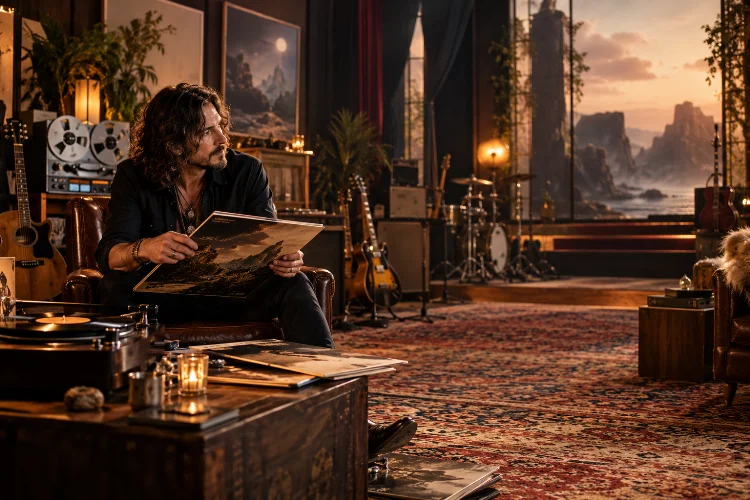
For much of popular music history, an album could simply function as a container for songs.
One track might be about romance, the next about dancing, and another might exist mainly because the band needed enough material to fill the record. Concept albums challenged that approach.
Instead of treating every song as an isolated piece, musicians began connecting tracks through characters, recurring themes, musical motifs, sound effects, or complete storylines.
By the late 1960s and 1970s, rock artists were increasingly using the LP format almost like filmmakers or novelists used their chosen medium.
That shift explains how concept albums transformed rock music into narrative art. The album was no longer simply a collection of potential singles. It could become a carefully structured journey that rewarded listeners for following it from beginning to end.
From Sgt. Pepper’s Lonely Hearts Club Band and Tommy to The Dark Side of the Moon, 2112, and The Wall, musicians proved that rock could tell stories on a scale far larger than one three-minute song.
Concept Albums Changed the Meaning of the Rock Album
The rise of the LP gave musicians more time to think beyond individual singles.
By the mid-1960s, artists were increasingly interested in making albums that felt unified. The Beach Boys’ Pet Sounds and The Beatles’ Sgt. Pepper’s Lonely Hearts Club Band became particularly important to the development of album-oriented rock.
The Rock & Roll Hall of Fame’s progressive-rock history identifies both records as major influences on the idea that songs across an album could relate to a larger concept.
Sgt. Pepper’s was not a continuous narrative in the later rock-opera sense, but its fictional-band framework encouraged listeners to think about the album as a complete artistic experience.
The Beatles themselves described the idea of temporarily becoming an imaginary band, giving them greater freedom to experiment with arrangements and studio technology.
That developement changed expectations.
An album could now have its own identity rather than simply displaying twelve unrelated songs.
Rock Opera Added Characters and Continuous Plot
The next major step was turning albums into actual stories.
The Who’s Tommy, released in 1969, became one of rock’s landmark narrative works. The double album follows its central character through trauma, isolation, celebrity, spiritual discovery, and eventual disillusionment.
The Rock Hall archive describes Tommy as a conceptual rock opera centered on the spiritual journey of its main character.
This approach changed songwriting dramatically.
Each track now had two jobs.
It needed to work musically on its own while also advancing the wider narrative.
A song could introduce a character, describe an event, represent another point of view, or return to an earlier idea. That gave rock songwriting something closer to dramatic structure.
The technique also encouraged listeners to pay attention to sequence.
Skip several tracks and you might miss part of the story.
That was very different from a conventional album where the order could sometimes be rearranged without significantly changing the listening experience.
Recurring Musical Motifs Became Storytelling Devices
Concept albums did not rely only on lyrics to create continuity.
Music itself could tell the story.
A chord progression, melody, sound effect, or vocal phrase might appear near the beginning of an album and return much later. When listeners heard it again, they automatically connected the new moment with something that happened earlier.
This resembles the use of recurring motifs in film scores and classical music.
The melody effectively carries memory.
A theme introduced softly might later return with distorted guitars and drums, giving the same musical idea a completely different emotional meaning.
Progressive-rock musicians became especially interested in this technique.
The Rock Hall’s Genesis induction material notes how concept albums became one of prog rock’s most important experimental formats, with bands including Genesis, Yes, Rush, and Pink Floyd building entire releases around connected ideas.
This made repeated listening valuable.
The first time through, you hear songs.
Several listens later, you begin noticing how those songs speak to one another.
The Dark Side of the Moon Made Themes More Important Than Plot
Not every concept album needs a central character or linear storyline.
Pink Floyd’s The Dark Side of the Moon demonstrated how powerful a thematic concept could be.
Rather than telling one continuous fictional story, the album explores connected subjects including work, money, time, mortality, conflict, travel, and psychological pressure. Pink Floyd’s official site describes these universal concerns as central to the album’s design.
Songs flow into one another through sound effects, synthesizers, spoken voices, clocks, cash registers, and transitional textures.
The boundaries between tracks become less obvious.
This creates the sensation of one extended experience rather than ten completely seperated songs.
The production is therefore part of the storytelling.
Even without following every lyric, listeners understand that the album occupies a shared emotional world.
That helped establish another model for narrative rock: an album did not have to tell you exactly what happened. It could explore one idea from several angles.
Genesis Turned the Concept Album Into Surreal Fiction
Some progressive-rock bands pushed storytelling much further.
Genesis’ The Lamb Lies Down on Broadway, released in 1974, became one of the genre’s most ambitious narrative albums. The double LP follows Rael through a surreal series of encounters and transformations in a bizarre version of New York.
Genesis continues to identify it as a landmark 1974 album in the band’s official catalog.
The record works almost like a strange novel.
Characters appear, locations change, symbolic events unfold, and the central protagonist develops across multiple songs.
Instrumental passages also contribute to atmosphere.
Instead of using lyrics to explain every moment, Genesis allowed keyboards, guitar textures, rhythmic changes, and transitions to suggest emotional states.
This kind of narrativ storytelling demanded more attention from listeners.
Understanding everything during one casual play was difficult – and that was part of the appeal.
Fans could return to the album, read the lyrics, debate interpretations, and slowly construct their own understanding of the story.
2112 Used Science Fiction to Talk About Creative Freedom
Science fiction became another natural home for concept albums.
Rush’s 2112 demonstrated how futuristic storytelling could address ideas relevant to contemporary musicians.
The 1976 album’s side-long title suite takes place in a future society controlled by the Priests of the Temples of Syrinx. According to Rush’s official history, the authorities control books, music, images, and other aspects of culture until the central character discovers an old guitar.
The discovery represents something larger than an instrument.
It represents independent creativity.
That made the concept especially fitting for Rush, whose record label had reportedly discouraged the band from making another concept-oriented record. Rush ignored the advice, and 2112 became an important commercial breakthrough.
The form reinforced the message.
A long, unconventional rock suite about resisting creative control was itself an act of resisting commercial expectations.
Concept albums could therefore tell stories while simultaneously commenting on the conditions under which artists created them.
The Wall Combined Music, Character, Theatre, and Visual Art
Pink Floyd pushed narrative rock toward multimedia art with The Wall in 1979.
Its central character, Pink, becomes increasingly isolated as trauma, fame, relationships, and emotional damage create a metaphorical wall between him and other people.
The Rock & Roll Hall of Fame describes the work as a rock opera exploring isolation, fame, and personal collapse.
But the story did not remain inside the album.
Live performances physically constructed a wall across the stage. Animation, enormous characters, projections, costumes, and theatrical staging extended the narrative visually.
Eventually, the concept became a feature film.
That experimantation showed how far an album could expand beyond audio.
A concept could connect music, graphic design, theatre, filmmaking, and performance.
Modern artists now regularly create visual albums, narrative videos, cinematic concerts, and multimedia worlds around releases. The Wall helped demonstrate how naturally rock music could move in that direction.
Album Artwork Became Part of the Story
Concept albums also changed the importance of record packaging.
During the vinyl era, an LP sleeve provided a relatively large visual space. Artists could use gatefold covers, illustrations, photographs, lyric sheets, maps, symbols, and elaborate typography to deepen the album’s fictional or thematic world.
Pink Floyd became especially famous for this relationship between sound and image.
The prism artwork of The Dark Side of the Moon, for example, became inseparable from the identity of the record. Pink Floyd’s official history emphasizes the importance of visual presentation as the band’s musical concepts became increasingly ambitious.
Artwork could provide clues that lyrics never directly explained.
Listeners might study the cover while hearing the record, connecting symbols with songs or characters.
This made the physical album feel almost like an artifact from the story itself.
Although streaming reduced the physical scale of album artwork, the principle survived.
Today’s artists use music videos, websites, social media imagery, short films, and interactive experiences to build similar worlds.
Sequencing Turned Listening Order Into Narrative Structure
Another major innovation was careful sequencing.
With a conventional collection of songs, moving track seven ahead of track three might not make much difference.
On a narrative album, order can be essential.
An opening track introduces themes. The middle section creates conflict. Later tracks provide emotional or narrative resolution.
Transitions can reinforce that structure.
One song might end with a sound that continues into the next. A musical theme could disappear for half an hour before returning near the finale.
The Dark Side of the Moon demonstrates how effectively transitions can make individual tracks feel like movements within one continuous work. The band had even performed the material as a complete piece before finishing the studio album.
This changed listening behavior.
The album became something audiences were encouraged to experience in order.
That is closer to watching a film than shuffling a playlist.
Concept Albums Expanded What Rock Music Could Discuss
Narrative structure also gave rock musicians room to explore increasingly complex subjects.
A three-minute single can certainly address serious ideas, but an entire album provides space for multiple perspectives.
Artists could explore war, mental health, fame, political control, mortality, alienation, religion, personal trauma, or fictional worlds over forty minutes or more.
Pink Floyd became particularly successful at linking personal emotions with broader social themes. The Rock Hall highlights the band’s political, social, and emotional commentary and identifies The Dark Side of the Moon and The Wall among its most ambitious works.
This helped rock move beyond its reputation as primarily teenage entertainment.
An album could demand the same kind of attention audiences gave to literature or cinema.
It could contain characters, symbolism, irony, recurring imagery, unresolved questions, and multiple interpretations.
Rock had become narrative art.
The Concept Album Still Matters in the Streaming Era
Streaming encourages listeners to jump between individual tracks, but concept albums never truly disappeared.
If anything, the format has become more flexible.
Modern artists can combine albums with video, animation, social media, interactive websites, live visuals, and extended fictional universes.
Progressive rock, metal, hip-hop, alternative music, and pop have all continued exploring albums built around unified themes or narratives.
The technology has changed, but the fundamental attraction remains the same.
Listeners enjoy discovering connections.
A recurring lyric suddenly makes sense. An opening melody reappears during the final track. A character mentioned briefly early in the record turns out to be important later.
Those discoveries create an immerssive relationship with music that individual singles often cannot provide.
The concept album survives because it offers something playlists rarely do: a reason to experience the whole journey.
Concept albums transformed rock music into narrative art by expanding storytelling beyond the limits of individual songs.
Records such as Sgt. Pepper’s Lonely Hearts Club Band, Tommy, The Dark Side of the Moon, The Lamb Lies Down on Broadway, 2112, and The Wall demonstrated different ways an album could become a unified artistic statement.
Characters, recurring musical themes, sequencing, sound effects, visual design, and theatrical performances allowed musicians to build complete worlds rather than isolated tracks.
To understand why the format remains powerful, choose a classic concept album and listen from the first second to the last without shuffling.
Read the lyrics, notice recurring sounds, and follow how themes develop. You may find that you are not simply listening to an album – you are moving through a story.
