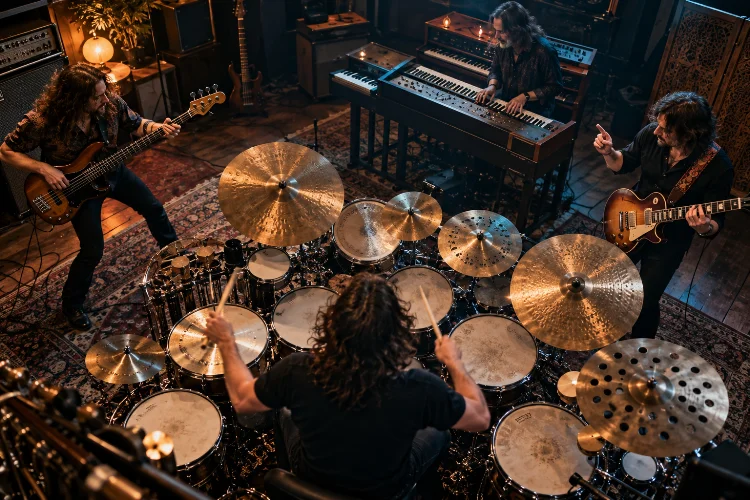
Most popular rock music gives listeners something comfortable to hold onto: four steady beats. Count “one, two, three, four,” repeat it, and you can follow thousands of songs without thinking much about rhythm.
Classic progressive rock had other ideas.
During the late 1960s, 1970s, and early 1980s, bands such as Yes, Genesis, King Crimson, Pink Floyd, and Rush began treating rhythm as another area for experimentation.
Instead of remaining in straightforward 4/4 time, they explored meters such as 5/4, 7/4, 7/8, and 9/8, sometimes switching between several patterns inside a single composition.
The result could sound complicated on paper, but the best progressive bands rarely used unusual meters just to confuse listeners. Complex time signatures in classic progressive rock often supported riffs, lyrics, tension, or dramatic changes in mood.
The Rock & Roll Hall of Fame’s progressive rock archive even highlights “offbeat time signatures” and dramatic rhythmic shifts as important characteristics of bands such as Yes.
So what actually makes these rhythms work? The answer is less mathematical than it first appears.
What Makes a Time Signature “Complex”?
A time signature tells musicians how beats are grouped inside a measure.
In 4/4, there are four quarter-note beats: one-two-three-four. This meter dominates rock because it creates a stable groove that is easy to dance to and easy for a rhythm section to maintain.
Odd meters organize beats differently.
A measure of 7/4 has seven quarter-note beats. Musicians rarely feel this as one giant count from one to seven. Instead, they usually divide it into smaller groups such as 4+3 or 3+4.
A 7/8 rhythm might feel like 2+2+3.
Once you start hearing those smaller groups, unusual meters become far less intimidating. They behave more like repeating rhythmic sentences than complicated equations.
Progressive rock musicians understood this extremely well. Their goal was usually not to make listeners count numbers. It was to create a groove that felt slightly unexpected while still having an internal logic.
Why Progressive Rock Embraced Odd Meters
Progressive rock grew from musicians who wanted to expand what a rock band could do.
They drew inspiration from classical composition, jazz improvisation, psychedelic rock, folk music, and experimental recording. Traditional verse-chorus structures and four-beat rhythms could sometimes feel too restrictive for those ambitions.
Yes became one of the clearest examples.
The Rock & Roll Hall of Fame describes the band’s music as complex, virtuosic rock built from psychedelic and classical influences. Its archival material also emphasizes Yes’s use of unusual time signatures and dramatic rhythmic changes.
Changing meter allowed progressive musicians to follow the shape of a melody or riff instead of forcing everything into 4/4.
If a guitar phrase naturally contained seven beats, they could simply write the music in seven.
That compositonal freedom became part of prog’s identity.
Pink Floyd Made 7/4 Sound Surprisingly Natural
One of the best entry points into unusual meter is Pink Floyd’s “Money.”
The song’s famous bass riff runs primarily in 7/4, meaning each repeating measure contains seven quarter-note beats rather than the familiar four.
Yet “Money” does not sound like a math exercise.
The riff itself makes the meter feel natural. Instead of consciously counting to seven, many listeners simply follow the shape of the bass line.
The unusual rhythm is reinforced by the famous opening tape loop of cash-register sounds and coins.
MusicRadar notes that Roger Waters built the loop around the unusual meter, while the song later switches into conventional 4/4 during David Gilmour’s guitar-solo section.
That change is especially instructive.
Once the track moves from seven beats to four, the solo suddenly feels more open and familiar. When the original pattern returns, the strange groove becomes immediately recognizable again.
“Money” demonstrates an important prog principle: odd meter can be catchy.
Genesis Turned 9/8 Into Musical Drama
Genesis approached unusual time signatures more theatrically.
Their 23-minute epic “Supper’s Ready,” released on Foxtrot in 1972, contains seven connected sections and moves through numerous moods and musical ideas. One of its most famous passages is literally titled “Apocalypse in 9/8.”
That name tells you exactly what is happening rhythmically.
The section uses a repeating nine-beat framework while keyboards, bass, guitar, and Phil Collins’ drumming build increasingly intense layers around it.
Tony Banks later recalled that Genesis wanted to push away from conventional structures, while accounts of the composition highlight how “Apocalypse in 9/8” became one of the piece’s defining moments.
The brilliance is not simply that Genesis could perform in 9/8.
The meter supports the atmosphere.
Its uneven momentum creates tension, while Collins’ drumming makes the pattern feel alive rather than mechanically counted. What could have sounded academically complicated instead becomes one of the track’s emotional climaxes.
That distinction is critical: progressive rock often used rhythmic complexity for storytelling.
Rush Made Shifting Meters Feel Like Rock Riffs
Rush brought a different personality to complex rhythm.
The Canadian trio combined progressive-rock complexity with the physical impact of hard rock. Bass, guitar, and drums could move through changing meters while still producing memorable riffs.
“Limelight” is an excellent example.
The song does not simply remain in one unusual meter from beginning to end. Its rhythms move through different groupings, including passages associated with 7/4, 6/4, and 3/4.
MusicRadar describes the composition as relying heavily on mixed time signatures and sliding meters while remaining remarkably catchy.
That balance was one of Rush’s major strengths.
Neil Peart could handle extremely precise rhythmic changes, while Geddy Lee and Alex Lifeson wrote parts strong enough that listeners did not need to understand the theory to enjoy them.
Rush proved that technical complexity and immediacy were not opposites.
You could count the measures if you wanted – or simply turn the volume up.
King Crimson Treated Rhythm as Interlocking Architecture
If some progressive bands used odd meters to decorate songs, King Crimson often made rhythmic structure the song itself.
Robert Fripp’s compositions frequently relied on repeating patterns that interacted in unexpected ways. Different instruments might emphasize different subdivisions, creating a feeling of rhythmic instability even when every player was completely synchronized.
This approach demanded exceptional awareness between musicians.
Fripp has described writing parts specifically around the abilities and responses of the musicians in King Crimson rather than treating compositions as generic pieces that any group could perform.
He recalled presenting the defining rhythm of “Larks’ Tongues in Aspic, Part Two” and having Bill Bruford and John Wetton immediately understand how to enter it.
That tells us something important about complex meter.
It is not only about counting.
Musicians eventually need to feel the pattern.
King Crimson’s music often sounds almost unstable because individual rhythmic lines rub against each other while remaining structurally connected.
The resulting experimantation later became enormously influential on progressive metal and math rock.
Meter Changes Can Create Tension and Release
One reason changing time signatures work so well is psychological.
Listeners quickly become accustomed to repetition. If a section establishes a pattern in 4/4 and suddenly removes or adds a beat, the listener feels that disruption even without knowing what happened technically.
Progressive musicians used this intentionally.
A verse might feel stable, while an instrumental bridge introduces an odd meter. Returning to 4/4 then feels like arriving home.
The reverse can also work.
Pink Floyd’s “Money” establishes 7/4 as its normal environment, meaning the transition into 4/4 actually feels like the rhythmic release.
This is why complex rhythms are most effective when connected to musical purpose.
Constantly changing meter for no reason can make a composition difficult to follow. But using rhythmic shifts to reinforce tension, excitement, instability, or resolution can make a track more expressive.
The best prog bands understood the difference.
Drummers Became Central to Progressive Rock Composition
Complex time signatures also changed the role of the drummer.
In conventional rock, drums often establish a dependable foundation while guitar, keyboards, and vocals carry most of the melodic development.
Prog drummers frequently became active compositional voices.
Bill Bruford’s work with Yes and King Crimson demonstrates this clearly. Rather than simply marking every obvious beat, he could place accents in unexpected locations, play around guitar patterns, or intentionally avoid emphasizing the rhythmic point listeners expected.
Neil Peart took another approach with Rush, combining technical precision with large fills and carefully structured percussion arrangements.
In both cases, drumming helped listeners understand complicated music.
A skilled drummer can make seven beats feel like a natural groove by emphasizing smaller internal groups. Instead of hearing 1-2-3-4-5-6-7, you may instinctively hear ONE-two-three-four, ONE-two-three.
Suddenly the rhythm becomes familar.
Complex Does Not Always Mean Difficult to Hear
One of the biggest misconceptions about progressive rock is that listeners need music-theory training to appreciate it.
They do not.
Many successful odd-meter passages work precisely because listeners stop noticing that they are unusual.
The bass line in “Money” is memorable enough to make 7/4 sound almost obvious. Rush could hide meter changes inside powerful guitar riffs, while Genesis used unusual rhythm to support theatrical drama.
Great progressive musicians often composed from riffs and phrases first, then identified the technical meter afterward.
That is also a practical way for listeners to approach these songs.
Instead of immediately trying to count everything, listen for where the musical phrase repeats. Tap along until you can recognize the cycle.
Only then start counting.
You may discover that what initially sounded chaotic actually repeats with remarkable consistency.
Odd Time Signatures Became Part of Prog’s Wider Legacy
Progressive rock’s rhythmic ideas did not disappear when the genre’s original commercial peak passed.
Later progressive metal bands expanded them dramatically. Artists associated with math rock, technical metal, alternative rock, and experimental music also embraced shifting meters and polymetric patterns.
The broader prog tradition continued as well. The Rock & Roll Hall of Fame’s overview traces its influence into later progressive metal and newer bands that continued adapting the techniques of early progressive groups.
What changed was the musical context.
A modern metal band might combine 7/8 rhythms with heavily distorted riffs. An experimental indie group might hide changing meters beneath relatively gentle melodies.
But the principle remains similar to classic prog: rhythm does not have to stay predictable.
Once rock musicians demonstrated that listeners could follow unusual meters, an enormous range of possibilities opened up.
Complex time signatures helped classic progressive rock escape the rhythmic predictability of traditional rock songwriting.
Bands such as Pink Floyd, Genesis, Rush, Yes, and King Crimson showed that 7/4, 9/8, mixed meters, and shifting accents could create memorable grooves rather than merely technical puzzles.
The key was musical purpose. Odd rhythms could build tension, follow the natural length of a riff, support a dramatic story, or make an instrumental passage feel completely unexpected.
If you want to understand these patterns, start by listening instead of calculating. Follow the bass or drum groove, identify where the phrase repeats, and then try counting it. Once your ears recognize the pattern, even the strangest prog rhythm can begin to feel surprisingly natural.