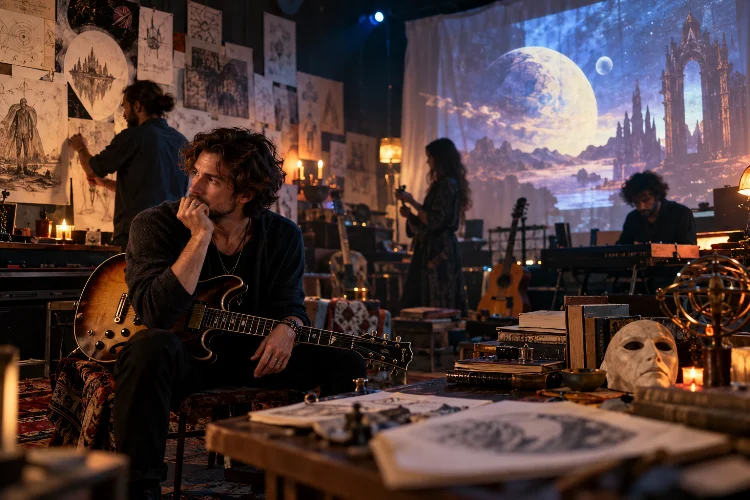
A rock album can simply be a collection of songs. Progressive rock musicians, however, often wanted something bigger. What if every track belonged to the same world?
What if melodies returned like characters in a novel, lyrics continued a story across an entire record, and instrumental passages carried parts of the narrative without saying a word?
Those questions became central to the evolution of conceptual storytelling in progressive rock.
Beginning in the late 1960s and expanding throughout the 1970s, prog musicians increasingly treated albums as complete artistic works rather than containers for individual singles.
Earlier psychedelic and art-rock records had already shown that albums could revolve around a unified idea.
Progressive bands pushed that concept further through long-form compositions, science-fiction stories, psychological narratives, recurring motifs, elaborate artwork, and theatrical concerts.
AllMusic identifies conceptually unified albums and the late-1960s British psychedelic scene as important foundations for progressive rock.
The result changed the relationship between storytelling and rock music. Sometimes the story was clear. Sometimes it was wonderfully confusing. Either way, listeners were invited to enter an entire musical world.
Concept Albums Changed the Role of the Rock Record
Before progressive rock reached its peak, albums were often structured around individual songs that could stand independently.
That began changing during the second half of the 1960s.
Artists increasingly experimented with records connected by themes, characters, musical ideas, or atmosphere.
Albums such as Sgt. Pepper’s Lonely Hearts Club Band helped demonstrate that an LP could be approached as a unified creative statement instead of simply a package of unrelated singles.
Progressive rock embraced that possibility enthusiastically.
The longer LP format gave musicians roughly forty minutes or more to develop an idea. Instead of explaining everything during one three-minute song, a band could introduce a theme, leave it unresolved, explore other perspectives, and return to it much later.
This encouraged a different style of listening.
Rather than jumping directly to a favorite single, audiences were often rewarded for playing an album from beginning to end.
Storytelling became connected to sequencing.
Where a track appeared could matter almost as much as what happened inside it.
Long-Form Suites Became Early Narrative Experiments
Prog storytelling did not always require an entire concept album.
Some bands built complete narratives inside a single extended composition.
Genesis’ “Supper’s Ready,” for example, stretches across multiple interconnected sections. Its changing scenes, surreal imagery, recurring ideas, and dramatic musical transitions make the piece feel closer to a miniature theatrical work than a conventional rock song.
This format gave musicians unusual freedom.
A peaceful acoustic section could represent one scene, while strange rhythms and aggressive keyboards could establish another. Instrumental transitions helped move the listener between moments without requiring a traditional verse or chorus.
The structure was particularly useful for symbolic stories.
Progressive lyrics frequently avoided straightforward explanations. Biblical references, mythology, fantasy, social commentary, and surreal imagery could overlap inside the same piece.
Listeners therefore had to interpret what they heard.
That ambiguity became part of the experience. Prog did not always tell a story like a film script. Sometimes it created fragments and allowed the audience to assemble the narrativ themselves.
Genesis Turned Albums Into Surreal Musical Worlds
Genesis became one of progressive rock’s strongest examples of theatrical storytelling.
Peter Gabriel’s lyrics frequently featured unusual characters, fantasy, satire, and shifting perspectives. On stage, he expanded those ideas through costumes, makeup, spoken introductions, and character-based performances.
The approach reached one of its most ambitious points with The Lamb Lies Down on Broadway in 1974.
The double album follows Rael, a young man moving through an increasingly surreal version of New York and a strange underground world. AllMusic describes the album as a full-scale concept work centered on Rael’s bizarre journey.
What made The Lamb important was its scale.
The story continued across numerous tracks rather than resetting every few minutes. Characters appeared and disappeared. Events from one song affected what happened later.
Music also helped shape the atmosphere.
Aggressive passages captured confusion and danger, while quieter moments created isolation or reflection.
Even when the storyline became difficult to follow, the album proved that progressive rock could function almost like a novel accompanied by an elaborate soundtrack.
Recurring Motifs Helped Connect Different Chapters
Conceptual storytelling works better when listeners can recognize connections.
Progressive musicians often created those connections through recurring musical motifs.
A melody introduced during an opening track might disappear and return thirty minutes later. A lyrical phrase could reappear with a completely different meaning. A chord sequence might accompany the same character or emotional idea.
These techniques resemble devices found in film scores and classical composition.
They allow music itself to remember earlier events.
Pink Floyd became particularly effective at this approach. Their concept albums frequently used recurring sound effects, melodies, lyrical phrases, and transitions to create continuity between tracks.
Instead of hearing a hard stop followed by an unrelated song, listeners might hear one piece dissolve directly into the next.
This created the impression that the album never truly stopped.
For storytelling, that continuity was extremely powerful. The spaces between songs disappeared, allowing the entire record to feel like one long psychological or cinematic experience.
Pink Floyd Made Inner Conflict the Story
Progressive storytelling was not limited to fantasy and science fiction.
Pink Floyd increasingly focused on psychological and social themes.
The Rock & Roll Hall of Fame describes the group’s later work as conceptually ambitious and strongly concerned with political, emotional, and social commentary.
Albums such as The Dark Side of the Moon were connected less by a conventional plot than by recurring themes. Time, death, money, mental pressure, conflict, and human anxiety became parts of one broader meditation on modern life.
Then The Wall moved closer to a rock opera.
Its central character, Pink, gradually constructs a metaphorical wall around himself as trauma, fame, failed relationships, isolation, and psychological collapse accumulate. The narrative eventually reaches a surreal internal trial in which that wall is confronted.
This represented an important development.
A progressive concept did not need dragons, distant planets, or mythical characters.
A person’s damaged inner world could provide enough material for an entire double album.
Rush Brought Science Fiction Into the Prog Narrative
Science fiction was another natural partner for progressive rock.
The genre already favored synthesizers, long compositions, unusual soundscapes, and complex arrangements. Futuristic narratives fit comfortably within that musical environment.
Rush’s 2112 became one of the best-known examples.
The album’s title suite occupies the entire first side of the original LP and is divided into seven sections. Its story takes place in a future society where authorities control creative expression until a protagonist discovers an ancient guitar.
Music becomes part of the plot itself.
The discovery of the instrument represents individual creativity, while the authorities’ reaction turns musical freedom into a conflict about control.
That creates an interesting relationship between form and subject.
Rush was telling a story about artistic independence while using a lengthy, unconventional composition that itself resisted commercial expectations.
The success of 2112 showed that ambitious storytelling and heavy rock could coexist.
Album Artwork Became Part of the Narrative
Conceptual storytelling was not restricted to sound.
Progressive rock emerged during an era when vinyl LP packaging gave artists a large visual canvas.
Gatefold sleeves, illustrations, photography, lyric sheets, and elaborate typography could expand the fictional world of an album.
A listener might study the cover while hearing the record, searching for connections between visual clues and lyrics.
For prog artists, this became another storytelling layer.
Artwork could establish a location before the first song started. It could introduce symbols that appeared in the lyrics or suggest interpretations the music never explained directly.
This made buying a record feel different from simply hearing a song on the radio.
The physical object became part of the experience.
That relationship between visual design and music remains important today, even though streaming has reduced the prominence of large album sleeves.
Modern conceptual artists still use cover art, videos, websites, stage design, and social media to extend a story beyond the recording itself.
Live Shows Turned Concept Albums Into Theatre
Progressive rock eventually pushed storytelling from records onto the stage.
Genesis became famous for Peter Gabriel’s theatrical costumes and characters. Pink Floyd transformed The Wall into an enormous live production involving projections, animation, stage characters, and a physical wall constructed during the show.
The concept was no longer something listeners only imagined.
They could watch it unfold.
This made progressive concerts closer to multimedia theatre than conventional rock performances.
Lighting could signal emotional changes. Visual projections could introduce symbols. Costumes transformed singers into characters, while stage structures physically represented ideas from the lyrics.
The experimantation eventually influenced many later artists.
Modern arena tours frequently combine narrative videos, elaborate staging, character transformations, synchronized lighting, and recurring visual themes.
Prog helped demonstrate that concert design itself could tell a story.
Ambiguous Stories Encouraged Active Listening
Not every progressive concept offered a clear plot.
In fact, confusion was sometimes part of the attraction.
Progressive lyrics often relied on symbolism, surrealism, philosophical references, mythology, and deliberately unclear imagery. Listeners could disagree for decades about exactly what a song meant.
That made the audience more active.
Instead of receiving a straightforward message, listeners searched lyric sheets, compared recurring phrases, and developed personal theories.
This approach worked particularly well with albums designed for repeated listening.
A musical detail that seemed irrelevant during the first play might become meaningful later. A recurring melody could suddenly reveal a connection between two apparently unrelated tracks.
Conceptual rock therefore rewarded attention.
The best albums did not always explain everything. They created enough structure for listeners to explore while leaving enough uncertainty to keep the interpretation open.
Prog Storytelling Expanded Beyond the 1970s
The original progressive-rock boom slowed toward the end of the 1970s, partly as punk and other movements reacted against prog’s complexity and grand scale.
But conceptual storytelling never disappeared.
Progressive metal later adopted many of the same techniques: recurring characters, science-fiction narratives, psychological themes, long suites, and album-wide story arcs.
Neo-prog musicians continued the tradition as well, while concept albums spread far beyond progressive music.
Metal, alternative rock, hip-hop, electronic music, and modern pop artists have all created albums where tracks contribute to larger stories or themes.
The technology has changed too.
Artists can now combine music with animation, short films, interactive websites, games, and social media.
In that sense, the progressive-rock idea became even more relevant: an album does not have to be merely a collection of songs.
It can be an entire fictional universe.
The evolution of conceptual storytelling in progressive rock transformed the album into a format capable of carrying complex narratives, characters, recurring themes, and entire imagined worlds.
Genesis used surreal characters and theatrical storytelling, Rush explored futuristic conflict, while Pink Floyd turned psychological isolation and social pressure into large-scale musical narratives.
Recurring motifs, extended suites, artwork, and ambitious live productions made those stories feel bigger than individual tracks.
Prog’s real achievement was proving that rock music could tell stories on the scale of novels, films, or theatre without abandoning the power of the band itself.
To experience that approach properly, choose a classic concept album and play it from beginning to end. Follow the lyrics, recurring sounds, characters, and musical callbacks. The deeper you listen, the more the album starts to feel like a world rather than a playlist.