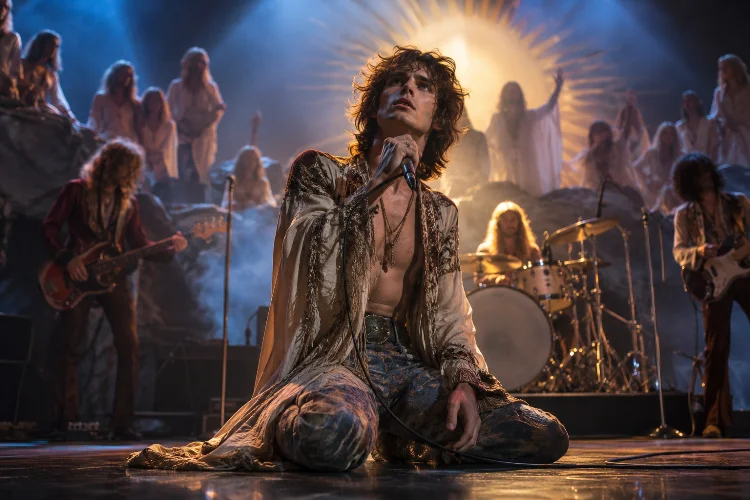
When Tommy arrived in 1969, rock albums were already becoming more ambitious. Psychedelic production, concept records, and longer compositions had expanded what bands could do beyond the traditional three-minute single.
The Who, however, pushed the idea in a particularly dramatic direction: they built an entire double album around a central character and an unfolding story.
Mostly written by guitarist Pete Townshend, Tommy follows a traumatized boy who becomes disconnected from the outside world, develops an extraordinary talent for pinball, gains a devoted following, and eventually experiences the collapse of his spiritual movement.
The Who’s official history describes the record as the first album overtly billed as a “rock opera.” Understanding how Tommy by The Who influenced the development of rock opera means looking beyond its unusual plot.
The album demonstrated that rock songs could function like scenes, motifs could return like theatrical themes, and an LP could carry a narrative from beginning to end.
Tommy Gave the Rock Album a Dramatic Story Arc
One of Tommy‘s biggest innovations was treating the album as a narrative rather than simply a themed collection of songs.
The record begins with an “Overture,” immediately borrowing language associated with theatre and opera. From there, tracks such as “It’s a Boy,” “1921,” “Amazing Journey,” and “Christmas” gradually establish Tommy’s background and psychological condition.
Later songs introduce important characters and conflicts.
“The Acid Queen,” “Cousin Kevin,” and “Uncle Ernie” represent different people Tommy encounters, while “Pinball Wizard” transforms him from an isolated figure into a public phenomenon.
The official track sequence contains 24 pieces, creating enough space for the story to develop over two LPs.
This was crucial to rock opera’s developement.
Individual songs no longer needed to contain complete stories. They could function as chapters inside something much larger.
Recurring Musical Ideas Created Narrative Unity
A long story told through separate songs can easily become fragmented.
Tommy avoids some of that problem by bringing musical ideas back throughout the album.
Themes introduced during the overture reappear later in different contexts. Certain melodies, chord movements, and lyrical ideas act almost like musical memories, reminding listeners of earlier events.
This technique has strong connections with opera and musical theatre.
A recurring theme can represent a character, emotion, or important idea without requiring the lyrics to explain everything again.
The result makes Tommy feel more unified than a normal double album.
Tracks are seperated physically, but they often sound as though they belong to the same musical world.
Later rock operas and progressive concept albums would use similar techniques extensively. Recurring riffs and melodies became an effective way to connect forty, sixty, or even ninety minutes of music.
Pinball Wizard Proved Story Songs Could Also Become Hits
One possible problem with a rock opera is accessibility.
If every song depends completely on the larger story, casual listeners may struggle to enjoy individual tracks.
“Pinball Wizard” demonstrated another possibility.
Within Tommy, the song plays a specific narrative role: it describes Tommy’s almost supernatural ability to dominate a pinball machine despite his inability to communicate normally with the world around him.
Yet the track also works perfectly well outside the album.
Released as a single in March 1969, it reached number four in the United Kingdom and number five in the United States, according to The Who’s official chronology.
That balance became extremely important for later concept records.
A songwriter could contribute to a larger narrative while still creating memorable standalone songs.
Rock opera did not have to sacrifice hooks in order to tell a complicated story.
Tommy Expanded the Role of the Rock Composer
The album also changed expectations around songwriting.
Pete Townshend was not simply writing lyrics around riffs. He had to think about characters, chronology, recurring themes, dramatic pacing, and how one track would lead into another.
That required something closer to architectural planning.
A songwriter working on a rock opera needs to ask different questions from someone writing an ordinary single.
What does the audience know at this point? Which character should speak next? Should an earlier melody return? Does the next song move the plot forward, or does it reveal something about the protagonist?
Tommy helped demonstrate that a rock composer could think on that scale.
The Who’s own retrospective describes the double album as a milestone that strengthened Townshend’s reputation as a composer and transformed the band’s career.
Rock songwriting was becoming narrativ composition.
Live Performance Turned the Album Into Theatre
Tommy became even more influential because The Who did not leave the concept inside the studio.
They performed substantial portions—and eventually essentially the entire work—onstage.
According to the band’s official 1969 history, Tommy was previewed for the UK press at Ronnie Scott’s Club before its release, then performed to enthusiastic American audiences during the following months. The band’s success increased dramatically during this period.
The Who even took the work into spaces associated more closely with formal performance traditions. Their European opera-house tour opened at the London Coliseum in December 1969.
This helped establish a central principle of rock opera.
The album could be performed as a complete dramatic work rather than simply providing several songs for a normal concert set.
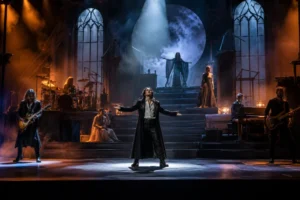
Later artists would take this much further with costumes, sets, projected films, characters, and elaborate visual narratives.
The Story Could Move Between Different Media
Another major part of Tommy‘s legacy was its adaptability.
The story did not remain fixed in its original 1969 recording.
Ken Russell directed a film version released in the 1970s, expanding the narrative into cinema with Roger Daltrey playing Tommy and a cast that included major music and film figures.
The concept later became a theatrical musical.
Rock & Roll Hall of Fame archival material notes that The Who’s Tommy debuted at California’s La Jolla Playhouse in 1992 under director Des McAnuff.
That transformation demonstrated something powerful about rock-opera architecture.
If characters, conflicts, and themes are strong enough, they can survive beyond the original recording.
Songs can become theatrical scenes. Instrumental themes can support stage movement. Lyrics can become dialogue-like moments inside a larger dramatic experience.
Tommy therefore helped establish rock opera as something closer to multimedia storytelling than a simple album genre.
Tommy Helped Make Long-Form Rock Commercially Viable
Experimental ambition means little to the music industry if nobody listens.
Tommy proved that audiences were willing to embrace a demanding double album.
The record reached number two in the UK and number four in the United States. The Who’s official album history also notes that it returned to the Billboard charts several times, accumulating 126 weeks there – longer than any other Who album.
The band’s own history says the record’s success dramatically improved its finances and helped transform The Who into one of Britain’s biggest live rock acts.
That success mattered to other musicians.
A complex story spread across two records no longer looked automatically like commercial disaster.
Rock artists could be ambitious and still reach a large audience.
That encouraged further experimantation with concept albums, progressive suites, and narrative-driven records throughout the 1970s.
Its Influence Can Be Heard in Later Rock Operas
Tommy did not create every idea associated with conceptual rock, but it provided an unusually visible blueprint.
Later albums expanded different parts of that blueprint.
The Who themselves returned to large-scale storytelling with Quadrophenia. Pink Floyd built an intensely psychological rock opera with The Wall. Progressive bands developed even more elaborate narratives across long suites and double albums.
The influence was structural as much as musical.
A central protagonist could connect dozens of songs. Musical themes could return at key moments. An album could open like a theatrical work, build conflict across several sides of vinyl, and eventually arrive at a dramatic resolution.
The Rock Hall has even presented an exhibition dedicated to the evolution of Tommy across its different forms, including album manuscripts, stage material, instruments, and other artifacts.
That continuing attention reflects how strongly the project changed expectations around what a rock album could become.
Tommy influenced the development of rock opera by proving that rock music could sustain characters, plot, recurring musical ideas, and dramatic development across an entire double album.
Its overture, interconnected songs, narrative sequencing, and theatrical possibilities gave later artists a practical model for long-form musical storytelling.
Just as importantly, Tommy succeeded commercially and moved naturally from record to concert, film, and stage production. That showed musicians that rock opera could be both ambitious and accessible.
To hear its influence clearly, play the album from “Overture” through “We’re Not Gonna Take It” without shuffling. Follow how melodies return and how Tommy changes between songs.
Heard that way, Tommy stops feeling like a collection of classic tracks and starts revealing the architecture that helped rock become theatre.