A concept album can connect songs around a theme. The Wall went much further. Pink Floyd built an entire psychological world where childhood trauma, war, education, relationships, fame, isolation, and political fantasy gradually become pieces of one enormous metaphor.
Released in November 1979, The Wall follows Pink, a fictional rock star partly shaped by Roger Waters’ own experiences and aspects of former Pink Floyd leader Syd Barrett.
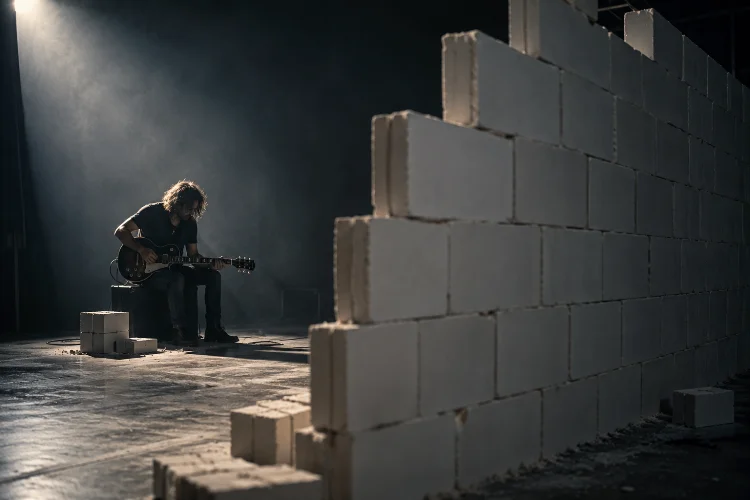
Each painful experience becomes another “brick” in the emotional wall Pink constructs between himself and everyone around him.
Pink Floyd’s official history traces the project’s origin to Waters’ growing alienation during the 1977 Animals tour, particularly a notorious Montreal concert that intensified his desire to imagine a physical barrier between performer and audience.
That foundation explains how Pink Floyd’s The Wall redefined conceptual rock narratives. It was not simply an album with related songs. Music, recurring images, sequencing, theatre, animation, and eventually cinema all became parts of one story.
The Wall Turned Personal Alienation Into Narrative Structure
The core metaphor is brilliantly simple.
Whenever something hurts Pink, another brick goes into his wall.
The death of his father during the war becomes one brick. His controlling mother becomes another. Cruel teachers, romantic failure, the pressures of fame, and emotional instability continue adding layers until Pink is almost completely isolated.
Pink Floyd’s official description calls the album partly autobiographical and explains that these painful experiences progressively construct the wall around its central character.
That structure gave the album unusual clarity.
Listeners did not need to understand every symbolic reference immediately. They only needed to understand what the wall represented.
Isolation grows one experience at a time.
That simple metaphor allowed Waters to connect personal trauma with broader subjects such as authoritarianism, war, education, celebrity culture, and the damaged relationship between performers and audiences.
Pink Became More Than a Typical Rock-Opera Character
Rock operas had used fictional characters before The Wall, but Pink was unusual because much of the drama happened inside his own mind.
He is not primarily traveling through fantasy kingdoms or fighting an external villain.
His greatest conflict is psychological.
As Pink withdraws from other people, listeners gradually experience his mental breakdown from inside the character’s perspective. Songs such as “Mother,” “Don’t Leave Me Now,” “Nobody Home,” and “Comfortably Numb” reveal different stages of his emotional disconnection.
The Rock & Roll Hall of Fame describes The Wall as a narrative about a rock star’s emotional breakdown built around isolation, fame, and personal collapse.
That approach helped expand the possibilities of narrative rock.
A concept album did not require an elaborate external plot.
Depression, memory, alienation, and distorted perception could provide just as much dramatic material.
Recurring Motifs Made the Album Feel Like One Long Work
One reason The Wall feels unusually unified is repetition.
The phrase “another brick in the wall” appears in multiple forms, but repetition extends far beyond those songs.
Melodic ideas, sound effects, lyrical phrases, characters, and symbols return across the double album.
Each repetition carries new meaning.
A musical idea heard during Pink’s childhood may reappear later when his mental state has become much darker. The same wall that initially appears protective eventually becomes a prison.
This is similar to the use of leitmotifs in opera or film scoring.
Music becomes a form of memory.
The album’s ending adds another layer. Pink Floyd’s official description asks whether the collapse of the wall truly ends the story or simply begins the cycle again.
That ambiguity makes the structure feel almost circular rather than completely resolved.
Track Sequencing Functions Like Film Editing
Try putting The Wall on shuffle and much of its power disappears.
The order matters because the songs function like scenes.
The first part introduces Pink’s childhood and early emotional damage. Later sections follow his relationships, increasing isolation, collapse, authoritarian fantasies, internal trial, and eventual destruction of the wall.
Transitions frequently connect one song directly to another.
Sound effects, voices, television audio, crowd noise, and musical fragments reduce the feeling that listeners are jumping between separate tracks.
Instead, scenes seem to dissolve into each other.
That was crucial to the album’s narrativ design.
“Another Brick in the Wall, Part 2” works as a famous standalone single, but within the complete record it occupies a specific moment in Pink’s development.
The song becomes more meaningful when heard alongside “The Happiest Days of Our Lives” and the childhood material surrounding it.
The Music Changes as Pink’s Mind Changes
Pink Floyd also used musical style as storytelling.
The album moves between quiet acoustic passages, orchestral arrangements, heavy rock, disco-influenced rhythm, theatrical vocals, sound collage, and enormous guitar solos.
Those changes are rarely random.
As Pink becomes increasingly isolated, the music can feel colder and more claustrophobic. When his fantasies become authoritarian and violent, the arrangements grow more aggressive and theatrical.
Then there is “Comfortably Numb.”
Its contrast between detached verses and David Gilmour’s expansive guitar sections creates an emotional scale that lyrics alone could not provide.
The band’s ability to move between intimate and enormous sounds helped transform Pink’s inner world into something listeners could almost physically feel.
This is where The Wall differs from a simple collection of story songs.
The production participates in the plot.
The Wall Blurred Personal Trauma and Political Symbolism
One of the album’s most daring moves occurs when Pink’s private isolation mutates into authoritarian fantasy.
During songs such as “In the Flesh,” “Run Like Hell,” and “Waiting for the Worms,” the damaged rock star imagines himself as a fascistic leader controlling a violent audience.
This escalation turns the story outward.
Personal isolation becomes a metaphor for something socially dangerous.
A person cut off from empathy can transform fear and resentment into hatred.
The Rock Hall notes that the work eventually fused personal trauma with broader political symbolism, a connection that became even more visible when Roger Waters staged The Wall in Berlin in 1990 after the fall of the Berlin Wall.
That gave the concept a reach far beyond celebrity autobiography.
The wall could represent emotional defenses, political divisions, ideological barriers, or the seperation between performers and audiences.
Its meaning could expand depending on context.
“The Trial” Functions as the Narrative Climax
Every strong dramatic structure needs a point where its central conflict can no longer be avoided.
For The Wall, that moment is “The Trial.”
Instead of presenting a realistic courtroom, the song turns Pink’s psychological crisis into surreal musical theatre.
Figures associated with his trauma return as grotesque witnesses, including the schoolmaster, his wife, and his mother.
Pink effectively puts himself on trial.
The verdict is unexpected: the wall must come down.
This is a clever reversal.
For most of the album, building the wall seems like Pink’s method of protecting himself. By the climax, that protection has become the actual problem.
The solution is vulnerability.
Musically, “The Trial” sounds intentionally theatrical rather than like conventional Pink Floyd rock. That stylistic shift reinforces the idea that listeners have entered a distorted internal courtroom rather than another ordinary scene.
The climax therefore works through music, character, symbolism, and structure simultaneously.
The Stage Production Made the Metaphor Physical
The Wall became even more revolutionary when Pink Floyd took the concept onstage.
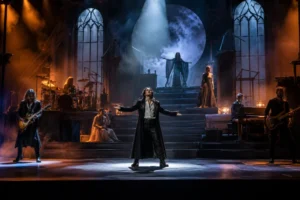
During the 1980–81 performances, a huge wall was gradually constructed across the stage until it obscured the musicians themselves.
The metaphor became literal.
According to the Rock & Roll Hall of Fame, the production featured enormous inflatable characters while the wall was built during the concert and eventually destroyed. The original Pink Floyd production was performed in its entirety 31 times across four cities.
This changed what a rock concert could represent.
The stage was no longer simply a platform where musicians reproduced songs from an album.
It became part of the story.
The audience watched the central metaphor physically appear in front of them.
That kind of multimedia experimantation helped establish a model later used by enormous arena and stadium tours involving narrative video, theatrical sets, projection mapping, costumes, and cinematic staging.
Gerald Scarfe’s Visual Language Expanded the Story
Another essential element was illustrator and animator Gerald Scarfe.
Pink Floyd officially credits the concept to Roger Waters and its visual realization to Scarfe.
His grotesque teachers, hammers, creatures, and distorted human forms gave the story a recognizable visual vocabulary.
The Teacher, for example, stops being merely a person from Pink’s childhood.
Through Scarfe’s imagery, he becomes an exaggerated symbol of institutional cruelty.
The same transformation happens with other characters.
Visual distortion reflects psychological distortion.
This approach made The Wall unusually cohesive because album design, concert staging, animation, and music all seemed to belong to the same universe.
The story was no longer confined to lyrics.
You could recognize The Wall visually before hearing a note.
The 1982 Film Completed the Multimedia Transformation
The concept eventually became Pink Floyd – The Wall, directed by Alan Parker and released in 1982.
The film starred Bob Geldof as Pink and combined live-action sequences with Scarfe’s disturbing animation.
BFI describes it as a bleak musical with relatively little dialogue, using songs and animated sequences to explore Pink’s loneliness, wartime loss, institutional oppression, and emotional defenses.
This was important because the story changed medium without simply becoming a filmed concert.
Images could now show scenes that the album had only suggested.
Childhood memories, war, fascist fantasies, destroyed relationships, and psychological breakdown became visual events.
At that point, The Wall existed simultaneously as album, concert production, visual-art project, and feature film.
Few conceptual rock projects had integrated so many forms on such a scale.
The Wall Changed Expectations for Narrative Rock
The album’s influence reaches far beyond bands that sound like Pink Floyd.
Its larger lesson was that a rock narrative could operate on several levels at once.
There could be a recognizable protagonist and storyline for listeners who wanted a clear plot.
There could also be symbolism for listeners interested in psychological interpretation.
Political themes could exist underneath both.
Visual design could add another layer, while stage production could reinterpret everything again.
The Rock Hall identifies The Wall alongside The Dark Side of the Moon as one of Pink Floyd’s most ambitious works and notes how the group demonstrated that deeply personal torment could resonate with massive audiences.
That may be its greatest narrative achievement.
The story is extremely personal, yet the central image is universal.
Almost everyone understands the instinct to build emotional walls.
Pink Floyd’s The Wall redefined conceptual rock narratives by turning an album into a complete psychological and multimedia experience.
Pink’s character arc, recurring motifs, carefully controlled sequencing, political symbolism, and gradual emotional collapse gave the music a dramatic architecture normally associated with novels, theatre, or film.
The live production then made the central metaphor physical, while Gerald Scarfe’s imagery and the 1982 film expanded the story beyond sound.
To experience why the album remains so influential, listen from “In the Flesh?” through “Outside the Wall” without shuffling. Follow each new brick, notice which ideas return, and watch how protection slowly becomes imprisonment.
The Wall works best when treated not as a playlist of classic songs, but as one long story about what happens when isolation becomes a world of its own.