A rock opera is more than a collection of songs that happen to share a theme.
At its best, it works almost like a novel, stage musical, or film: characters are introduced, conflicts develop, musical ideas return, and the final tracks resolve – or deliberately refuse to resolve – the story.
That structure explains why albums such as The Who’s Tommy, Quadrophenia, Pink Floyd’s The Wall, and Genesis’ The Lamb Lies Down on Broadway feel different from ordinary concept records. The listener is not simply moving from track to track. They are following a narrative.
Understanding the storytelling architecture of rock opera albums means looking at how music and story support each other.
Lyrics provide characters and events, but sequencing, recurring motifs, instrumental transitions, changes in tone, and even album artwork can help carry the plot.
Some rock operas tell clear stories. Others are deliberately surreal. Either way, the strongest examples create a sense that every song belongs to something larger.
Rock Operas Begin by Establishing a World
Good narrative albums usually establish their world early.
The opening songs need to tell listeners where they are, what kind of story they are entering, and which emotional rules apply.
The Who’s Tommy, released in 1969, does this quickly through an overture and short narrative songs.
The double album tells the loose story of Tommy, a traumatized boy who later becomes the center of a messianic movement. The Who’s official store describes it as the first musical work explicitly billed as a rock opera.
Using an overture is especially important.
It borrows from theatre and opera, previewing musical themes that will later return. Listeners subconsciously become familiar with melodies before the characters and conflicts fully develop.
That makes later reprises feel meaningful rather than random.
Characters Give the Album a Narrative Center
A story becomes easier to follow when listeners have someone to follow.
Rock operas often revolve around one central character whose emotional or physical journey connects otherwise different songs.
In Quadrophenia, that character is Jimmy, a young Mod struggling with identity, frustration, belonging, and disillusionment in 1960s Britain. The Who describes the album as a coming-of-age story built around Jimmy and his difficult relationship with Mod culture.
Pink Floyd used a similar strategy with Pink in The Wall.
Pink’s experiences with family, school, relationships, fame, and emotional trauma become metaphorical “bricks” in the wall he builds around himself.
Pink Floyd’s official description presents the album as a partly autobiographical story in which those painful experiences gradually produce isolation.
A strong protagonist gives each track a narrativ purpose.
Songs become chapters rather than isolated singles.
Conflict Creates Momentum Between Songs
Once the protagonist and world are established, the album needs pressure.
Without conflict, even beautiful songs can feel disconnected.
Rock operas often build tension gradually. A character wants freedom, identity, love, recognition, or escape, while social forces, personal trauma, authority figures, or internal weaknesses prevent them from getting it.
Rush’s 2112 uses this architecture in a science-fiction setting.
Its side-long suite follows a protagonist living under the control of the Priests of the Temples of Syrinx. After discovering an old guitar, he realizes that creative expression once existed outside the system’s control.
Rush’s official history describes the story as taking place in a society where authorities regulate books, music, images, and much of everyday life.
The guitar is therefore not simply a prop.
It becomes the story’s central symbol of individuality.
Recurring Motifs Work Like Narrative Memories
Rock operas rarely rely on lyrics alone.
Recurring melodies, riffs, chord progressions, sound effects, and lyrical phrases help listeners remember earlier parts of the story.
This technique works much like a cinematic theme.
When a familiar melody returns in a new context, the audience remembers its previous meaning. If the arrangement has changed, that difference can show how the character has changed too.
The Wall uses this technique repeatedly.
Musical ideas and lyrical phrases return across the album, while the recurring image of the wall itself links childhood trauma, adulthood, fame, isolation, and eventual psychological collapse.
The album even has a cyclical quality. Its ending can be interpreted as connecting back toward its beginning, suggesting that the emotional pattern may continue rather than being completely resolved.
That kind of structure turns repetition into storytelling.
Sequencing Functions Like Chapter Order
Track order matters enormously in a rock opera.
Move the songs around and the story may stop making sense.
A traditional album can sometimes survive random playback because each track is largely independent. A rock opera usually depends on sequence because information revealed early changes how later songs are understood.
The Wall is a clear example.
Its first half gradually constructs Pink’s psychological barrier. Later tracks explore the isolation behind that wall before the story escalates toward authoritarian fantasy, self-confrontation, and “The Trial.”
Transitions can reinforce that continuity.
Sound effects, instrumental passages, spoken voices, and repeated musical fragments reduce the feeling that songs are seperated objects.
Instead, one scene flows into another.
This is why listening to a rock opera on shuffle can feel like watching a movie with the scenes rearranged.
Musical Style Can Represent Character and Emotion
Rock opera storytelling is not limited to words.
Instrumentation can tell us how a character feels.
A quiet acoustic section may suggest vulnerability. A distorted guitar riff can signal anger or danger. An orchestral passage might make a moment feel theatrical, while unusual time signatures can create confusion or instability.
Genesis used this approach extensively on The Lamb Lies Down on Broadway.
The 1974 double album follows Rael through a surreal journey in New York, with shifting musical environments supporting his strange experiences and personal transformation. Rhino describes the album as a concept work centered on Rael’s journey of self-discovery.
The music does not simply sit underneath the narrative.
It creates the emotional landscape.
This is one reason progressive rock became such fertile territory for rock operas. Musicians could change meter, instrumentation, harmony, and arrangement whenever the story required a new atmosphere.
The Climax Brings Musical and Narrative Threads Together
Strong rock operas usually build toward a recognizable dramatic peak.
Earlier conflicts become unavoidable. Recurring motifs return. Characters must finally confront what the previous songs have been preparing.
In The Wall, this occurs dramatically during “The Trial.”
Pink’s internal collapse becomes a surreal courtroom scene, after which the wall is ordered to come down.
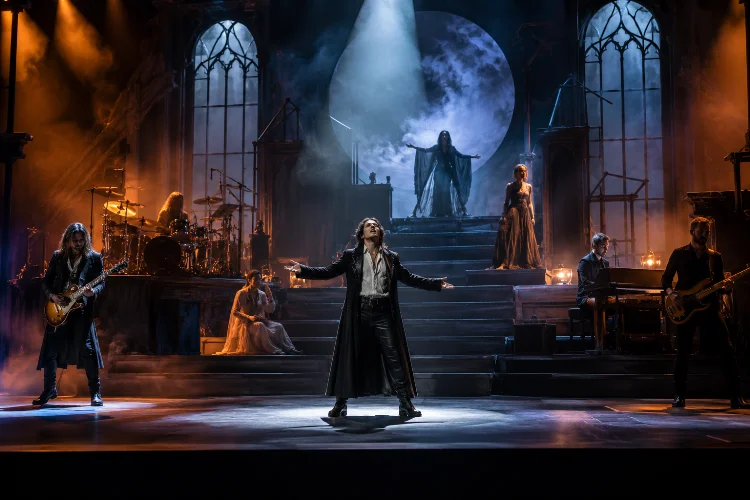
The Rock & Roll Hall of Fame describes the larger work as an exploration of isolation, fame, and personal collapse, later expanded into a theatrical production where an actual wall was constructed and destroyed onstage.
That staging reveals something important about rock-opera architecture.
The climax is often bigger than one song.
Music, lyrics, imagery, performance, and symbolism can all converge at the same point.
The audience experiences the resolution rather than merely hearing about it.
Resolution Does Not Always Mean a Happy Ending
Traditional stories often offer clear closure.
Rock operas do not have to.
Some end with reconciliation. Others finish with ambiguity, tragedy, repetition, or emotional uncertainty.
That flexibility makes the format especially interesting.
Quadrophenia, for instance, follows Jimmy through alienation and disillusionment rather than presenting a simple heroic victory. The Who has described the story as one involving lost youth, rebellion, belonging, and the false freedom Jimmy initially finds in Mod culture.
The Wall also leaves room for interpretation.
The physical and emotional barrier collapses, but its cyclical structure raises the possibility that similar patterns could begin again.
Ambiguous endings often make these albums more immerssive because listeners continue thinking about the story after the final note disappears.
The storytelling architecture of rock opera albums depends on much more than writing connected lyrics. Strong examples establish a world, introduce characters, develop conflict, use recurring musical motifs, control track sequencing, and build toward a dramatic climax.
Albums such as Tommy, Quadrophenia, The Lamb Lies Down on Broadway, 2112, and The Wall show how different musicians used that structure to explore identity, authority, trauma, rebellion, and self-discovery.
The best way to understand a rock opera is to treat it like a complete work rather than a playlist. Start at track one, follow the characters, notice which melodies return, and pay attention to how the music changes with the story.
Once you hear that architecture, the album begins to feel less like a collection of songs and more like a stage production built inside your headphones.